
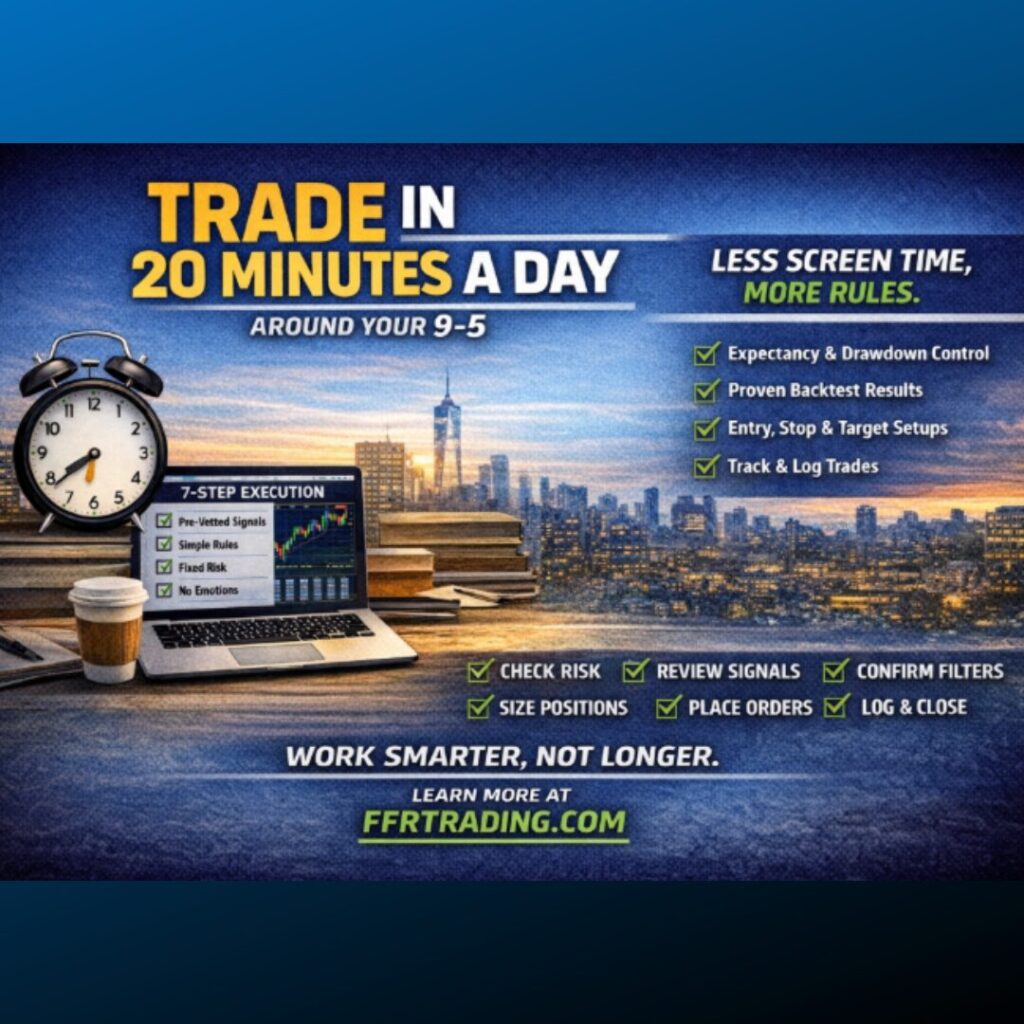
If you want market exposure without turning trading into a second job, the concept of the 20-minute trader changes everything. Instead of chasing charts all day, successful traders are increasingly relying on pre-vetted algorithmic signals to execute with precision, consistency, and calm—often in less time than it takes to finish a cup of coffee.
Why More Screen Time Isn’t the Answer
The traditional approach—watching charts for hours—sounds productive, but it usually leads to:
- Alert fatigue
- Overtrading
- Emotional decision-making
- Inconsistent results
Busy professionals don’t have the luxury of staring at screens all day. And ironically, that constraint can become an advantage.
Less time forces better structure.
And structure is what produces repeatable outcomes.
What Makes a “Pre-Vetted Signal” Legitimate
Not all signals are created equal. A real trading signal isn’t a guess or a “hot tip”—it’s a rules-based system.
At its core, a high-quality signal answers three questions:
- When do I enter?
- When do I exit?
- How much do I risk?
Before trusting any system, serious traders run it through four critical checks:
1. Expectancy
Does the system make more on winners than it loses on losers over time?
2. Drawdown Tolerance
What’s the worst historical loss streak—and can you realistically stick through it?
3. Sample Size
Are there enough trades to validate the results?
4. Live vs. Backtest Alignment
Does real-world performance reasonably match historical testing?
Bottom line:
Risk management matters more than win rate. Always.
The 20-Minute Trading Routine (Daily Execution Stack)
Once a signal is vetted, execution becomes mechanical. Here’s how disciplined traders operate:
Step-by-Step Workflow
1–2 minutes:
Check total open risk and daily loss limits.
3–5 minutes:
Review qualified signals that meet all criteria.
2–3 minutes:
Confirm filters (trend, volatility, timing).
3–4 minutes:
Calculate position size using a fixed risk model (1R).
3–4 minutes:
Place bracket orders (entry, stop, target).
1 minute:
Log the trade plan.
1 minute:
Close the platform.
That’s it.
No second-guessing. No mid-day tinkering.
Non-Negotiable Trading Rules
Consistency comes from discipline. These rules are critical:
- ❌ If one condition fails → No trade
- ❌ Never widen stops after entry
- ❌ Never move targets out of hope
- ✅ Always cap total portfolio risk
These aren’t suggestions—they’re guardrails.
Risk First: The Framework That Keeps You in the Game
The best traders think in terms of risk units (R), not dollars.
Core Risk Principles
- 1R Model: Define risk first, then size the trade
- Portfolio Heat: Limit total open risk to 3–4R
- Daily Stop: Shut it down at −2R
- Weekly Reset: Pause after hitting drawdown thresholds
- Slippage Control: Predefine acceptable execution variance
This framework ensures one bad day doesn’t spiral into a bad month.
Tools That Save Time (Without Over-Automating)
Efficiency isn’t about complexity—it’s about focus.
Use tools that support your system:
- Filtered watchlists (signal-only universe)
- Saved order templates
- Time-blocked execution windows
- Entry-specific alerts (not noise)
- Light automation for order placement
Let the rules drive decisions. Let the tools handle execution.
The 15-Minute Weekly Improvement Loop
Continuous improvement doesn’t require hours.
Just 15 minutes per week:
- ✅ Did you follow every rule?
- 📊 Which setups are profitable?
- 🔍 Where did emotion creep in?
- 🔧 Adjust one variable at a time
Avoid strategy hopping. It destroys statistical edge.
The Real Edge: Simplicity + Consistency
Time isn’t the enemy.
Unstructured decision-making is.
When you front-load the thinking into a proven system, execution becomes:
- Faster
- Cleaner
- More consistent
And most importantly—repeatable.
Ready to Get Started?
If you’re ready to simplify your trading and focus on structured, rules-based execution:
👉 Explore pre-vetted algorithmic signals designed for busy professionals:
https://www.ffrtrading.com
Final Thought
You don’t need more time.
You need better rules.
Twenty minutes. Same process. Every day.
That’s how disciplined traders stay calm—and stay consistent.