
A trading plan is one of the most valuable tools a trader can develop. Instead of reacting to headlines or emotions, a well-defined trading plan helps you manage risk, stay disciplined, and make better decisions under pressure.
Unfortunately, many traders spend more time searching for predictions than preparing for the market. As a result, emotions often take over when volatility increases. By creating a trading plan before the opening bell, you can trade with greater confidence and consistency regardless of market conditions.
What Is a Trading Plan?
A trading plan is a written set of rules that defines exactly how you approach the market. It outlines your entry criteria, exit strategy, risk management rules, and position sizing before a trade is ever placed.
Rather than making decisions in the heat of the moment, you simply follow the process you’ve already established.
Successful traders understand that consistency comes from discipline, not emotion.
How a Trading Plan Improves Decision Making
Many beginning traders start their day by watching financial television, scrolling through social media, or looking for someone else’s opinion.
Professional traders take a different approach.
Instead of asking, “What will the market do today?” they ask, “How will I respond if the market moves in either direction?”
Consequently, they spend less time reacting and more time executing their strategy.
Before the opening bell, experienced traders already know:
- Which markets they are watching
- Where they plan to enter
- How much capital they are willing to risk
- Where they will exit if they are wrong
- What conditions would invalidate the trade
Because those decisions have already been made, emotions have much less influence over the outcome.
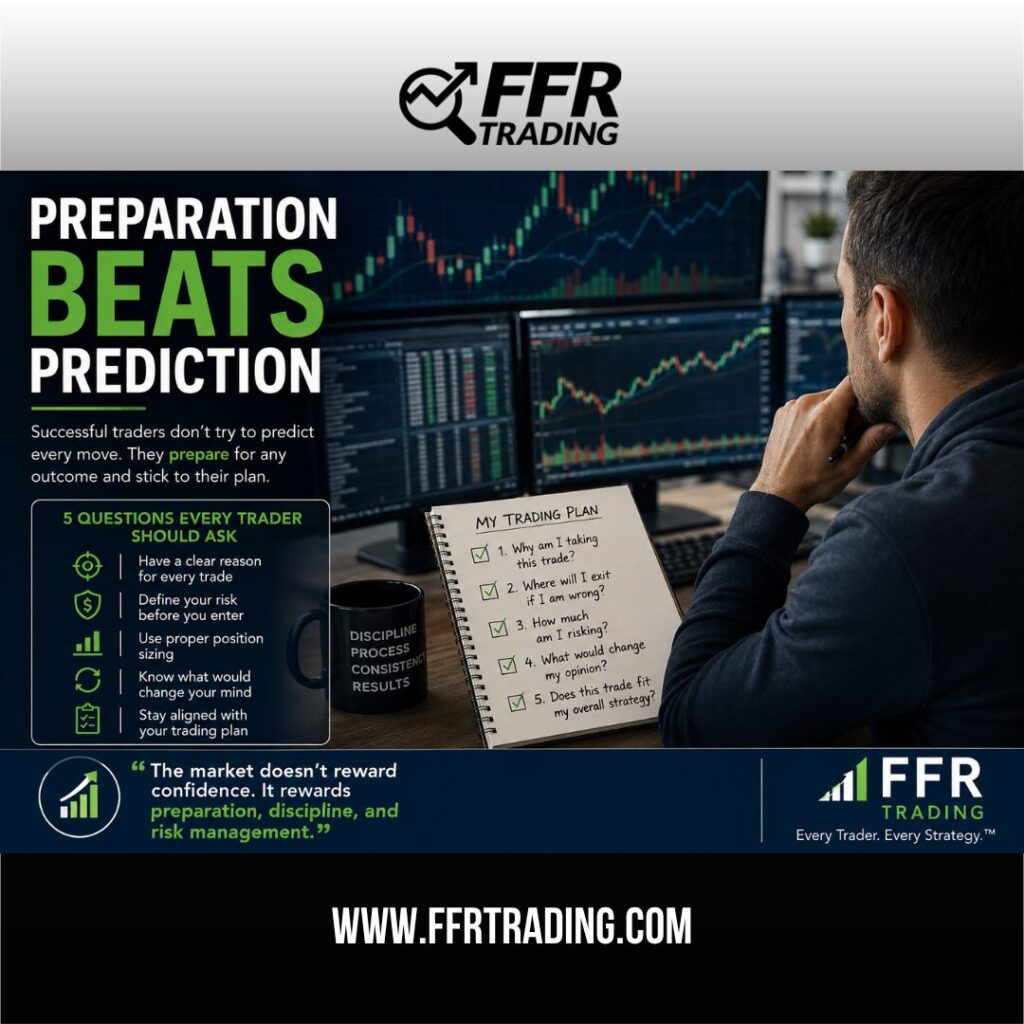
Five Questions Every Trading Plan Should Answer
Before placing your next trade, take a few moments to answer these five questions.
1. Why am I entering this trade?
Does the setup match your strategy, or are you simply reacting to price movement?
2. Where will I exit if I am wrong?
Every trade should have a predetermined exit point before you enter.
3. How much am I willing to risk?
Proper position sizing is often more important than finding the perfect entry.
4. What would change my opinion?
Professional traders know exactly what information would invalidate their original thesis.
5. Does this trade fit my overall trading plan?
Sometimes the highest-probability decision is waiting patiently for a better opportunity.
Why Professional Traders Trust Their Trading Plan
No trader predicts every market move correctly.
Even the most successful professionals experience losing trades. However, they continue to produce consistent results because they follow a repeatable process rather than making emotional decisions.
Markets change.
Volatility changes.
News changes.
Nevertheless, a disciplined trading plan provides structure regardless of market conditions.
Preparation builds confidence because it removes uncertainty.
Experienced traders already know what they will do if the market rallies, declines, or moves sideways. Therefore, they stay focused on execution instead of reacting to every headline.
The FFR Trading Philosophy
At FFR Trading, we work with professional traders who use different markets, strategies, and timeframes. Despite those differences, they all share one important characteristic:
They trust a disciplined process instead of trying to predict every market move.
Whether you trade stocks, options, futures, or ETFs, building a trading plan can improve confidence, consistency, and long-term results.
Final Thoughts
The market does not reward confidence alone.
Instead, it rewards preparation, discipline, and risk management.
The next time you sit down to trade, ask yourself a different question.
Rather than asking,
“What do I think the market will do today?”
ask,
“Does my trading plan prepare me for whatever the market decides to do?”
That simple change in mindset may become one of the most valuable improvements you ever make as a trader.
Related Resources
- Market Minute: Why Treasury Yields Matter
- Risk Management: Why Position Sizing Can Make or Break Your Results
- Trading Psychology: How Discipline Creates Consistency
Recommended External Resources
For additional educational information on investing and risk management, visit:
- U.S. Securities and Exchange Commission (SEC) Investor Education: https://www.investor.gov
- Commodity Futures Trading Commission (CFTC) Learn & Protect: https://www.cftc.gov/LearnAndProtect