
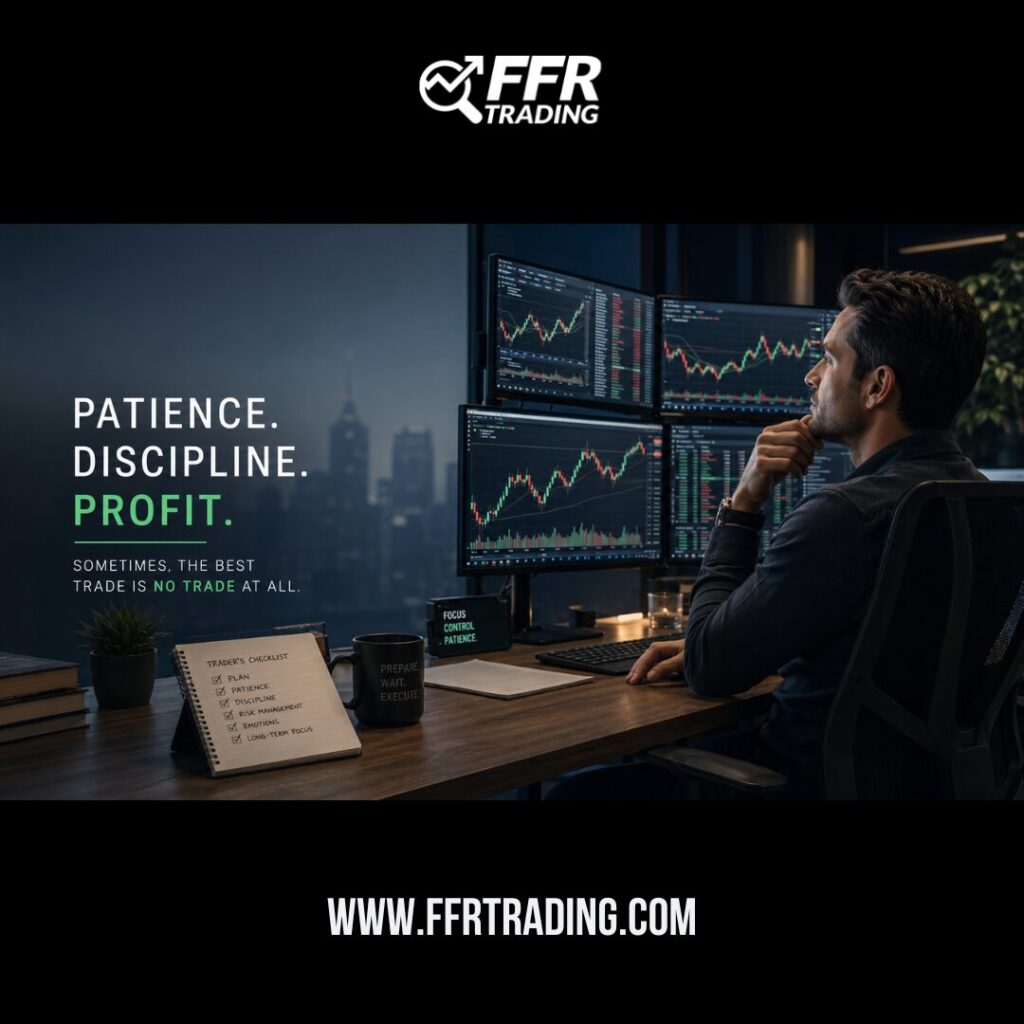
Trading often creates the feeling that you should always be doing something.
A chart is moving. News is breaking. Other traders are posting gains. It can seem as though every minute spent outside the market is a missed opportunity.
However, experienced traders understand an important truth: sometimes the best trade is no trade at all.
Waiting is not the same as being indecisive. It can be a deliberate risk-management decision made when the market does not offer a clear opportunity.
Why Traders Feel Pressured to Act
Many poor trades begin with boredom rather than a strong setup.
A trader watches the market for an hour without seeing anything that matches the plan. Eventually, the desire to participate becomes stronger than the discipline to wait.
This can lead to:
- Entering before confirmation
- Chasing a move after it has already happened
- Trading during unpredictable news events
- Accepting a setup that does not meet normal standards
- Increasing position size to make the trade feel worthwhile
The problem is not a lack of opportunity. It is the belief that every trading session must produce a trade.
Activity Is Not the Same as Productivity
In many professions, doing more can produce better results. Trading does not always work that way.
Placing more trades also creates more opportunities for:
- Commissions and fees
- Slippage
- Emotional mistakes
- Poor entries
- Unnecessary losses
A trader’s job is not to trade constantly. The job is to act when the potential opportunity justifies the risk.
That may mean taking several trades during an active session. On another day, it may mean taking none.
Conditions Matter
Even a strong strategy may struggle when market conditions do not support it.
For example, a breakout strategy may perform well when volume is strong and the broader market is trending. The same approach may produce repeated false signals during a slow, directionless session.
Before entering, consider:
- Is the market trending or moving sideways?
- Is volume supporting the move?
- Is a major economic announcement approaching?
- Is volatility unusually high or low?
- Does the setup meet the strategy’s written rules?
- Is the potential reward reasonable compared with the risk?
A setup should not receive a passing grade simply because it is the best one available. It should meet the standards you established before the session began.
Waiting Protects More Than Capital
Avoiding a questionable trade can protect your trading account, but it can also protect your mindset.
One impulsive loss can lead to frustration. Frustration may lead to another trade designed to recover the first loss. Before long, a small mistake can turn into an emotionally driven series of decisions.
Choosing not to trade helps preserve:
- Capital
- Confidence
- Emotional control
- Focus
- The ability to recognize the next legitimate opportunity
Cash is also a position. It gives you the flexibility to act when conditions become more favorable.
Define Your No-Trade Conditions
It is easier to remain disciplined when your reasons for staying out are written down in advance.
Your no-trade rules might include:
- No trades immediately before important economic announcements
- No entries when spreads or volatility exceed normal limits
- No trading after reaching a daily loss limit
- No entry without a predetermined exit plan
- No trade when the potential reward does not justify the risk
- No trade taken solely because of boredom or fear of missing out
These rules remove some of the emotion from the decision.
Instead of asking, “Can I find a reason to take this trade?” ask:
“Does this setup fully qualify under my plan?”
That small change in perspective can prevent many unnecessary trades.
Patience Is an Active Trading Skill
Waiting may look passive from the outside, but disciplined waiting requires work.
A patient trader is still:
- Reviewing price action
- Monitoring risk
- Comparing the setup with the trading plan
- Identifying important levels
- Preparing for different scenarios
- Protecting capital for a better opportunity
Patience is not inactivity. It is the ability to resist acting until the evidence supports a decision.
A Simple Pre-Trade Test
Before entering your next position, ask three questions:
- Does this trade meet every major requirement in my plan?
- Would I still take it if I had not seen anyone else trading it?
- Am I entering because of the setup—or because I feel pressure to act?
An honest answer may reveal that the strongest decision is to remain on the sidelines.
Final Thoughts
Successful trading is not measured by how often you participate. It is measured by the quality and consistency of your decisions over time.
There will always be another chart, another session, and another potential setup. You do not have to force today’s market to provide an opportunity.
Sometimes the best trade is the one you have the discipline not to take.
Trading Tip
Before each session, write down the conditions that would cause you to remain out of the market. Deciding in advance makes it easier to avoid emotional trades later.
Trading involves risk and may not be suitable for everyone. This article is for educational purposes only and should not be considered individualized financial or trading advice.