
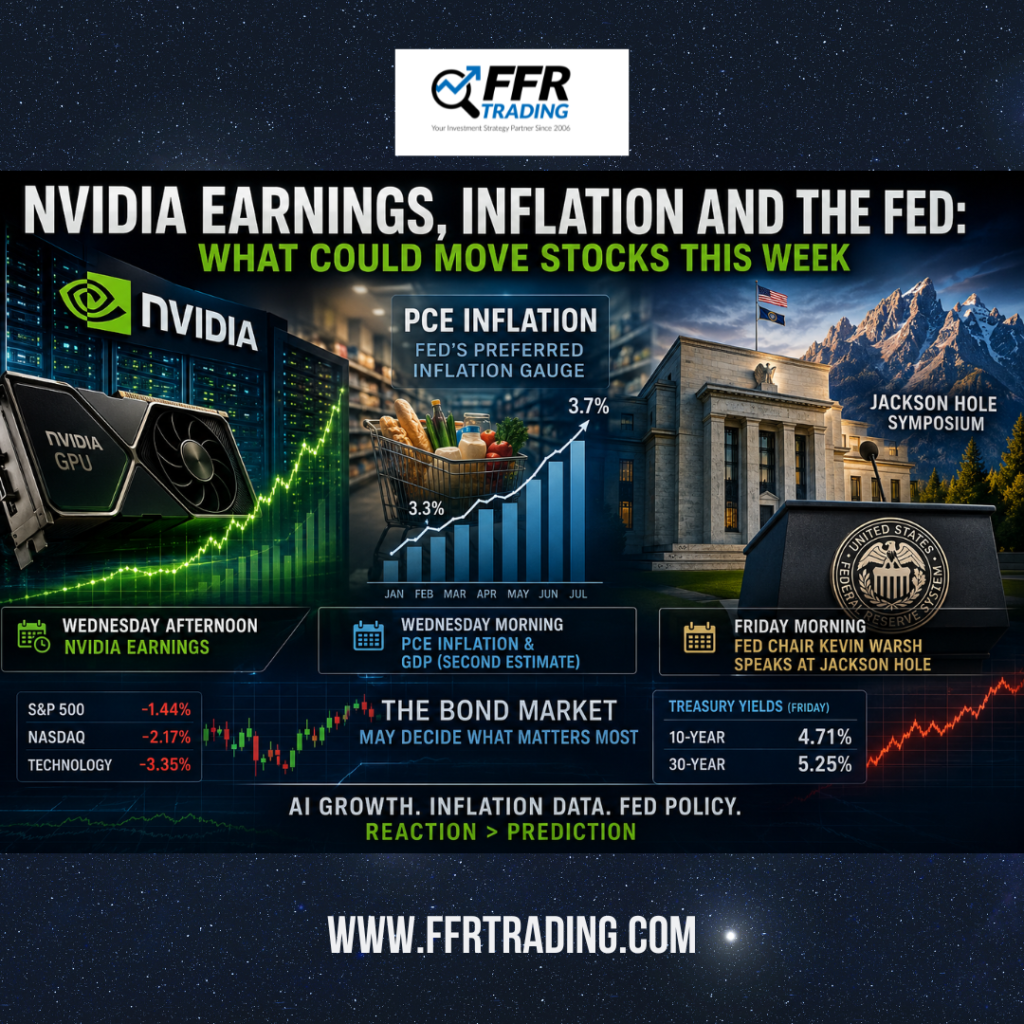
Nvidia earnings and inflation will take center stage this week after rising Treasury yields put renewed pressure on technology stocks.
The S&P 500 declined 1.44% last week while the Nasdaq Composite dropped 2.17%. Technology was among the weakest sectors, falling 3.35%.
The catalyst wasn’t collapsing corporate profits.
It was largely the bond market.
Long-term Treasury yields climbed sharply, with the 30-year yield reaching approximately 5.25% Friday.
That matters because higher yields can make expensive growth stocks less attractive while simultaneously increasing financing costs across the economy.
Now the market gets three major tests.
Test #1: Is Inflation Still Cooling?
Wednesday morning, the Bureau of Economic Analysis releases July Personal Income and Outlays, which includes the Federal Reserve’s closely watched PCE inflation indexes.
June headline PCE inflation was 3.7% year over year, while core PCE was 3.3%.
The July report arrives Wednesday, August 26 at 8:30 a.m. ET.
BEA Personal Income and Outlays release calendar
The number itself matters.
But traders should also watch something else:
How do Treasury yields react?
If inflation comes in cooler and yields fall, technology could receive some relief.
If inflation surprises to the upside and long-term yields climb again, richly valued growth stocks could face another headwind.
Test #2: Can Nvidia Justify AI Expectations?
Wednesday afternoon brings another enormous catalyst.
NVIDIA reports fiscal second-quarter results at approximately 4:20 p.m. ET, followed by its conference call at 5:00 p.m. ET.
NVIDIA Investor Relations earnings announcement
Nvidia has become more than another semiconductor company reporting earnings.
Its results have effectively become a quarterly report card for the AI infrastructure boom.
Investors will likely focus on several questions:
Is AI infrastructure demand still accelerating?
What does management say about data-center spending?
Are customers continuing to commit enormous amounts of capital?
What does guidance suggest about future demand?
And perhaps most importantly:
Are the results strong enough to justify expectations already embedded in the stock?
That last question matters because a company can deliver excellent earnings and still see its shares decline.
Stocks trade expectations—not simply earnings headlines.
Test #3: What Does the Fed Say at Jackson Hole?
Friday morning brings the final major catalyst.
Fed Chair Kevin Warsh is scheduled to deliver keynote remarks at the Jackson Hole Economic Policy Symposium at 10:00 a.m. ET on August 28.
Federal Reserve August calendar
Markets will listen closely for comments about inflation, economic growth and the future path of monetary policy.
But again, traders shouldn’t focus only on the speech.
Watch the reaction.
Treasury yields can provide an immediate indication of how bond investors interpret the Fed’s message.
Don’t Miss the Rotation Underneath the Market
Here’s where this week’s story gets more interesting.
Technology fell 3.35% last week.
But Health Care rose 4.32%.
Energy gained 2.58%.
Materials advanced 2.28%.
That is precisely why traders shouldn’t automatically equate a falling Nasdaq with a broken stock market.
Capital can move.
When one leadership group becomes expensive or faces a new headwind, money frequently rotates toward another area.
The better question isn’t:
“Is the market bullish or bearish?”
It may be:
“Where is the market rewarding risk right now?”
The Bigger Lesson
Wednesday could produce enormous headlines.
PCE.
GDP.
Nvidia.
Friday adds Jackson Hole.
But trying to predict every number isn’t necessary.
Instead, traders can prepare a decision tree.
Cooling inflation + falling yields + strong Nvidia guidance: potentially constructive for growth stocks.
Hot inflation + rising yields: renewed pressure on expensive technology.
Strong Nvidia + weak Nasdaq reaction: potentially important warning about expectations.
Weak Nvidia + technology holding support: potentially important evidence that bad news is already discounted.
Markets aren’t just moved by news.
They’re moved by the difference between news and expectations.
This week gives traders an unusually good opportunity to see that principle in action.