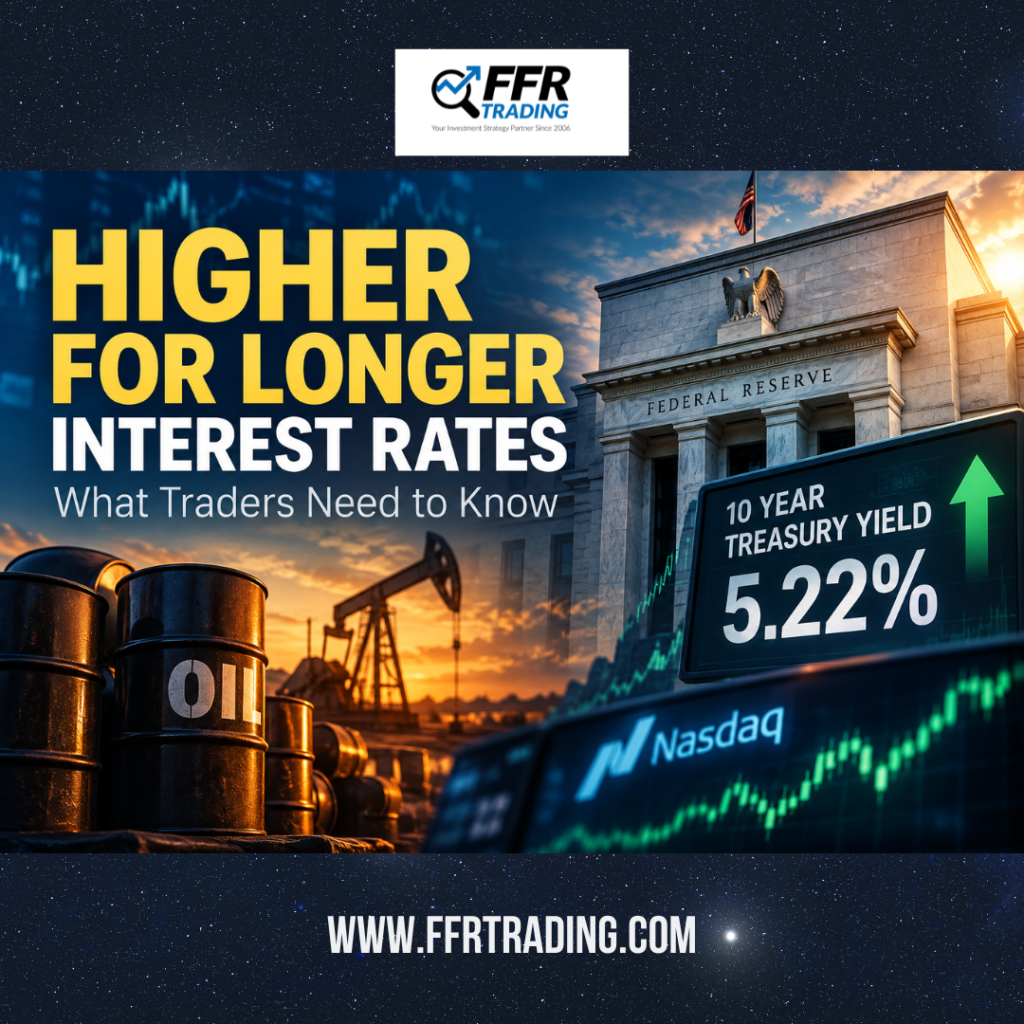
Investors spent much of the past few years waiting for interest rates to eventually move lower. But the bond market may be sending a different message.
With Treasury yields above 5%, oil prices elevated, and expectations for additional Federal Reserve tightening, higher for longer interest rates are becoming an increasingly important consideration for traders.
But “higher for longer” doesn’t necessarily mean interest rates will continue climbing indefinitely. It means investors may need to adjust to a world where borrowing costs remain elevated for longer than previously expected.
And that could change how traders evaluate stocks, sectors, and risk.
What Does “Higher for Longer” Actually Mean?
For years, businesses and investors benefited from historically inexpensive money.
Companies could borrow cheaply to expand operations, acquire competitors, repurchase shares, and invest in new technologies.
Higher rates change that equation.
If interest rates eventually settle at higher levels than investors became accustomed to, businesses may face permanently higher financing costs.
For traders, the important question isn’t simply whether the Fed raises rates again.
It’s whether markets are beginning to accept that higher rates may be the new normal.
Why Treasury Yields Have Surged
Several forces have contributed to the rise in Treasury yields.
Economic growth has remained resilient, inflation continues to be a concern, energy prices remain elevated, and investors are weighing the possibility of additional Federal Reserve tightening.
When investors expect interest rates to remain elevated, bond yields often adjust accordingly.
That matters because Treasury yields influence borrowing costs throughout the economy—from mortgages and corporate debt to the rates companies pay to finance expansion.
Why Higher Oil Prices Complicate the Picture
Energy prices add another challenge.
Higher oil prices can increase transportation and manufacturing costs throughout the economy. Businesses may absorb some of those expenses, but others may eventually be passed along to consumers.
That can make inflation more difficult to control.
If elevated oil prices contribute to persistent inflation, the Federal Reserve may have less flexibility to lower rates—even if other parts of the economy begin slowing.
For traders, that makes crude oil an important market indicator well beyond the energy sector.
Why 5% Changes the Investment Equation
There’s another reason a 5% Treasury yield matters.
Every investment competes for capital.
If investors can earn around 5% from government securities, riskier investments must offer enough potential return to justify taking additional risk.
That doesn’t mean investors suddenly abandon stocks.
But it can make them much more selective about the prices they’re willing to pay.
Companies with strong earnings, healthy cash flow, and manageable debt may be better positioned to navigate higher borrowing costs than businesses heavily dependent on inexpensive financing.
Why AI Companies May Face a New Test
Artificial intelligence provides a particularly interesting example.
Technology companies are spending enormous amounts of money on data centers, semiconductors, power infrastructure, and other resources needed to support AI development.
When capital is cheap, financing aggressive expansion becomes easier.
When borrowing costs rise, investors may begin asking tougher questions:
Is revenue growing fast enough to justify the investment?
Are AI projects generating sufficient returns?
Can companies continue financing expansion without damaging margins or cash flow?
This doesn’t mean the AI boom is ending.
It means due diligence becomes increasingly important when money isn’t cheap.
Do Higher Rates Mean Stocks Have to Fall?
No.
This is one of the most important lessons for traders.
A risk factor isn’t automatically a sell signal.
Stocks can continue advancing in a high-rate environment if earnings growth, economic strength, and investor demand are powerful enough to offset the pressure from higher borrowing costs.
Instead of assuming stocks should fall because Treasury yields are rising, traders should watch how the market actually handles those higher yields.
If stocks continue advancing despite elevated rates, that’s valuable information.
If leadership begins deteriorating as yields rise, that tells a different story.
Three Questions Traders Should Ask
Rather than trying to predict exactly where interest rates will go next, consider three questions:
Is earnings growth keeping pace with valuations?
Companies with rapidly growing profits may be better equipped to justify premium valuations despite higher rates.
Can companies finance growth profitably at higher rates?
Debt levels, cash flow, and capital requirements become increasingly important when borrowing costs rise.
Is price action supporting the fundamental story?
Strong fundamentals don’t guarantee higher stock prices. Traders should consider both the underlying business and what the market is actually doing.
The Bottom Line: Due Diligence Matters More When Money Isn’t Cheap
For years, low interest rates provided a powerful tailwind for businesses, investors, and financial markets.
If higher for longer interest rates become the new reality, traders may need to adjust.
That doesn’t mean abandoning stocks or assuming a major decline is inevitable. It means becoming more selective.
At FFR Trading, we believe markets are a weight-of-the-evidence exercise. No single economic report, Treasury yield, or Fed decision should determine an entire trading outlook.
Understanding earnings, valuations, market conditions, risk, and the methodology behind every strategy becomes even more important when the financial environment changes.
Good traders don’t defend their assumptions.
They test them—and adapt when the evidence changes.