
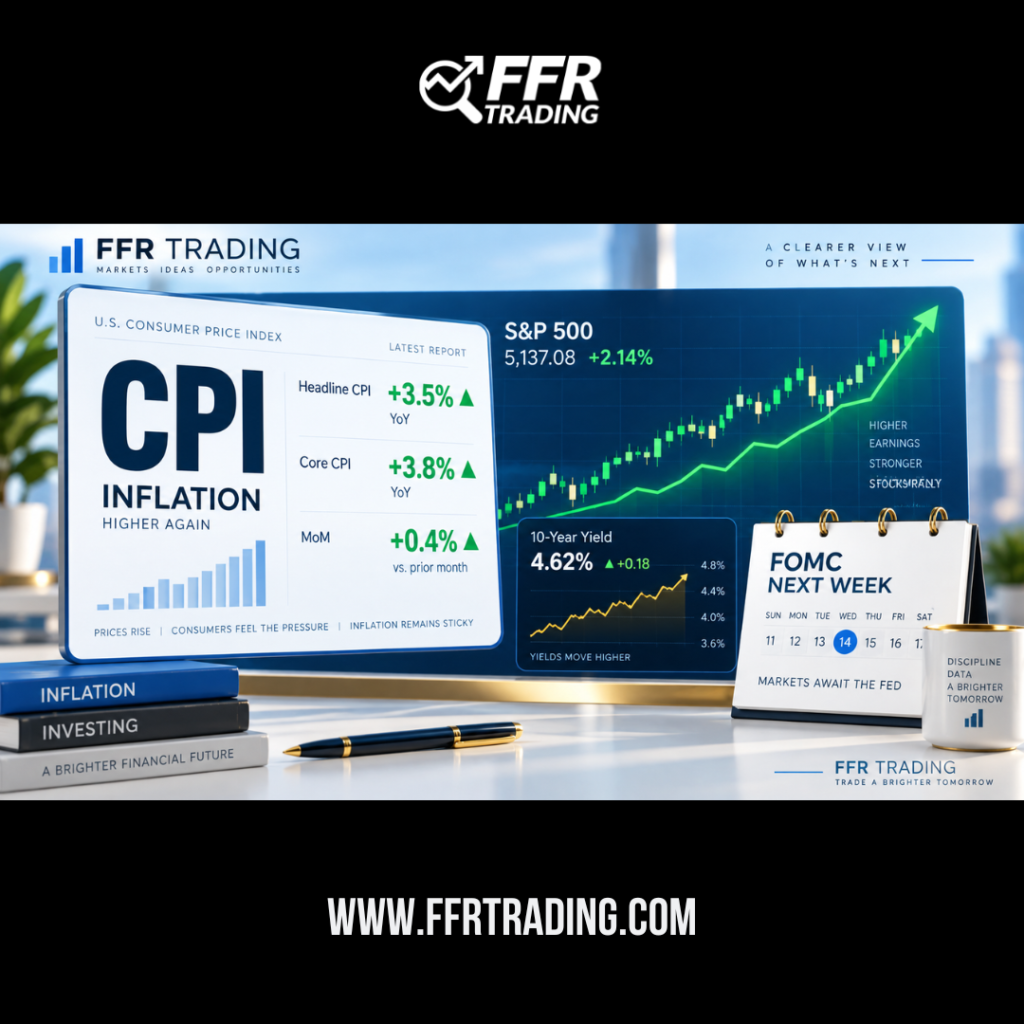
Friday delivered the inflation report the Fed and traders had been waiting for—and the market’s reaction may have been just as important as the number itself.
The Consumer Price Index rose 0.4% in August and 3.4% from a year earlier, as higher gasoline prices helped push headline inflation higher. Core inflation, which excludes food and energy, increased 0.3% for the month and 2.4% year over year.
Normally, hotter inflation would be a clear negative for stocks.
But Friday’s market reaction was different.
The S&P 500 rose about 1.1%, the Dow gained more than 600 points, and the Nasdaq also advanced as oil prices pulled back and investors appeared relieved that the inflation report wasn’t even worse.
That sets up an especially important Federal Reserve meeting next week.
Inflation Is Still a Problem
August’s inflation report reinforced the idea that price pressures have not disappeared.
Energy played a major role. Gasoline prices jumped sharply during the month as geopolitical tensions pushed crude oil higher.
But core inflation also remained firm.
That matters because the Federal Reserve is not simply watching energy prices. Policymakers are trying to determine whether broader inflation pressures are becoming entrenched.
With unemployment still relatively low, economic growth resilient and inflation remaining above the Fed’s 2% target, the central bank has less room to be patient.
The Market Is Now Expecting a Fed Hike
Following Friday’s CPI report, traders increased their expectations for a quarter-point rate hike at next week’s Federal Reserve meeting.
Market pricing moved to roughly an 85% probability of a hike, according to Reuters.
That is a major shift.
Just weeks ago, many investors were focused on when the Fed might eventually begin easing policy.
Now the conversation has changed to whether the Fed needs to tighten again.
For stocks, the bigger question may not simply be whether the Fed raises rates next week.
It may be what happens after that.
One Rate Hike—or the Beginning of Something Bigger?
If the Fed raises rates by 25 basis points and signals that the move is largely precautionary, markets may be able to absorb it.
But if policymakers suggest inflation requires a longer tightening cycle, the market could face a much tougher environment.
Higher rates can push Treasury yields even higher, raise borrowing costs and pressure equity valuations.
That is particularly important with the 10-year Treasury yield already hovering near 5%.
The 5% level has become something of a psychological line in the sand.
At those yields, investors can earn increasingly attractive returns from government bonds without taking the same level of risk associated with equities.
Oil Provided Some Relief Friday
There was at least one positive development.
Oil prices backed away from their recent highs Friday, with Brent crude falling after briefly approaching $110 per barrel earlier in the week.
That helped relieve some immediate inflation pressure and contributed to Friday’s rebound in stocks.
But oil remains volatile.
As long as geopolitical tensions remain elevated and global supply routes remain vulnerable, energy prices could quickly return as a major market catalyst.
What Traders Should Watch Next Week
The Federal Reserve meeting now becomes the obvious focal point.
But traders should watch more than the headline decision.
Pay close attention to the 10-year Treasury yield, the Fed’s language about future rate increases, the reaction in technology stocks and whether market breadth begins to improve.
The S&P 500 ended Thursday at 7,591.70, near an important support zone after four consecutive declines. Friday’s rebound was encouraging, but the market still needs to prove that buyers can maintain control.
The Bottom Line
Friday’s inflation report did not eliminate the market’s biggest concerns.
Inflation remains elevated. Treasury yields remain near multi-year highs. Oil remains volatile. And the Federal Reserve may be preparing to raise rates.
Yet stocks rallied anyway.
That tells us much of the bad news may already be reflected in prices—or at least that investors were prepared for a worse outcome.
Now attention shifts squarely to next week’s Fed decision.
The key question is no longer simply whether the Fed raises rates. It’s whether one hike is enough.
That answer could help determine whether Friday’s rebound becomes the start of a recovery—or simply another pause in the recent pullback.