
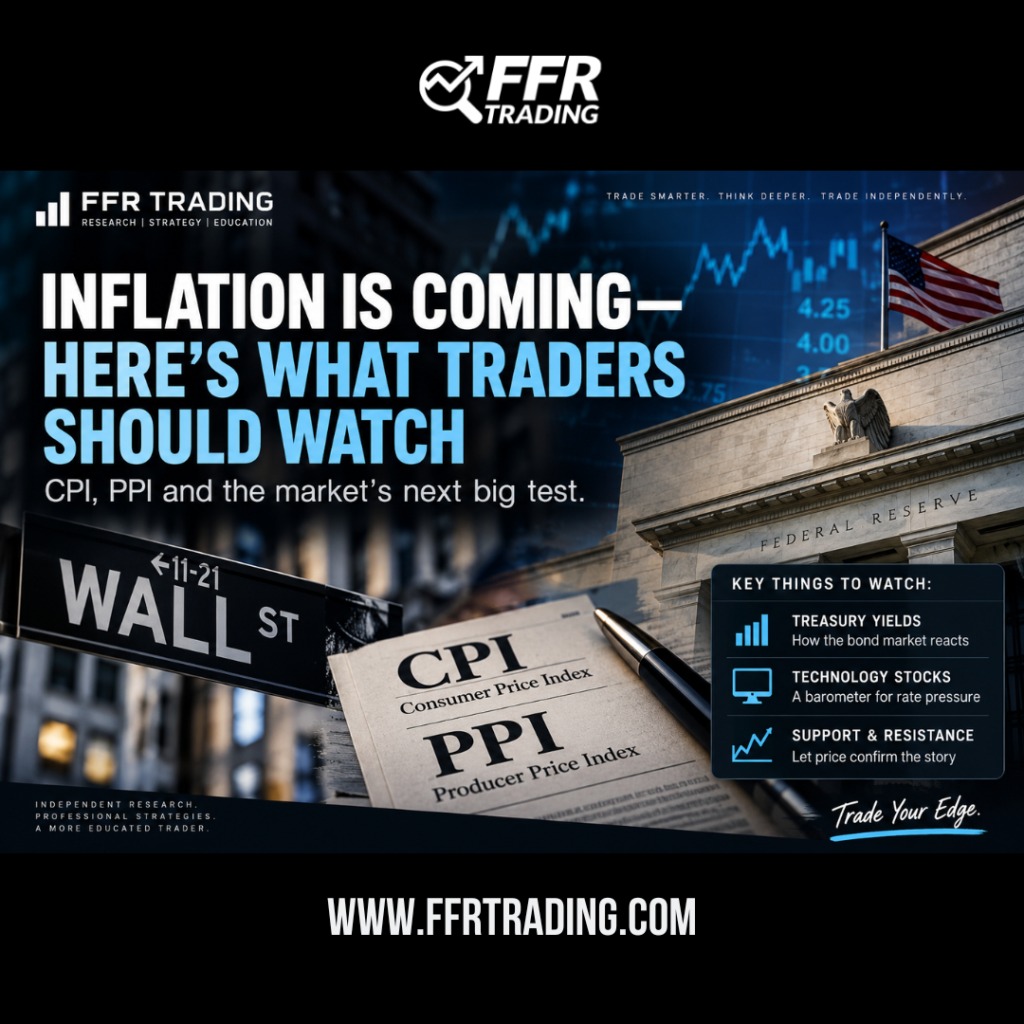
Inflation is about to return to center stage on Wall Street.
After last week’s surprisingly strong jobs report, traders are now turning their attention to two of the most important economic releases of the month: the Producer Price Index (PPI) on Thursday and Consumer Price Index (CPI) on Friday. Both are scheduled for 8:30 a.m. ET.
And this time, the inflation reports may carry even more weight than usual.
The Federal Reserve meets September 15–16, and markets are already wrestling with the possibility that stronger economic growth, rising oil prices and stubborn inflation could keep interest rates higher—or potentially lead to another rate hike.
For traders, however, predicting the CPI number may be less important than understanding how the market reacts after it arrives.
Why Inflation Matters to Stocks
Inflation affects stocks largely through interest rates.
When inflation runs hotter than expected, investors may conclude that the Federal Reserve needs to maintain tighter monetary policy.
That can push Treasury yields higher.
Higher yields can then create several challenges for stocks:
- Businesses face higher borrowing costs.
- Bonds become more competitive with equities.
- Higher discount rates can reduce stock valuations.
- Growth and technology stocks can become particularly sensitive.
We’re already seeing some of this pressure. The 10-year Treasury yield is approaching 5%, putting borrowing costs and equity valuations back in focus.
That makes the bond market particularly important this week.
Oil Adds Another Inflation Wild Card
There’s another complication traders shouldn’t overlook: oil.
Brent crude has climbed toward $100 per barrel amid escalating geopolitical tensions and disruptions involving Saudi energy infrastructure.
Higher energy prices can eventually work their way through transportation, manufacturing and consumer costs.
That doesn’t mean higher oil automatically produces higher CPI.
But it does mean inflation concerns are unlikely to disappear simply because one economic report comes in favorably.
Don’t Just Watch the CPI Number
This is where traders can learn something important.
Suppose CPI comes in hotter than economists expected.
Treasury yields initially jump.
But the S&P 500 sells off briefly and then recovers.
That reaction could be telling you something.
Investors may have already prepared for higher inflation, or underlying demand for stocks may simply be strong enough to absorb the news.
Now imagine the opposite.
CPI comes in cooler than expected.
Treasury yields fall.
But stocks can’t rally.
That’s potentially a warning sign.
The headline might appear bullish, but price action is telling you investors aren’t responding the way you would normally expect.
Three Things Traders Should Watch
1. Treasury Yields
This may be the most important secondary market to watch after the inflation reports.
If yields surge and remain elevated, stocks—particularly technology and other growth-oriented shares—could face additional pressure.
If yields initially jump but quickly retreat, that would tell a different story.
2. Technology Stocks
Technology can provide another useful gauge of how investors are interpreting inflation and interest rates.
If Treasury yields rise but technology stocks remain resilient, that’s worth noting.
If yields rise and technology begins breaking important support levels, the market may be signaling that rates are becoming a bigger problem.
3. Support and Resistance
Know the important levels before the report arrives.
Economic releases can create fast moves, but those moves often bring indexes and individual stocks directly into technical areas traders were already watching.
Instead of chasing the initial move, watch what price does when it reaches those levels.
Does support hold?
Does resistance break?
Does the initial move reverse?
Those reactions can sometimes provide more useful information than the economic headline itself.
The Market Is Always Comparing Reality With Expectations
One of the biggest mistakes investors make is assuming:
Hot inflation = stocks fall
or
Cool inflation = stocks rise
Markets aren’t that simple.
Prices reflect expectations.
If investors are already positioned for a bad inflation report, a slightly better number could produce a significant rally.
Likewise, an apparently good report may not help stocks if investors were expecting something even better.
That’s why experienced traders pay attention not only to the news—but also to the reaction to the news.
FFR Trader’s Takeaway
This week isn’t about guessing the CPI number.
It’s about being prepared for what happens afterward.
Watch Treasury yields, technology stocks and important technical levels.
Then ask one simple question:
Is the market reacting the way it should?
Sometimes the most valuable information isn’t contained in the economic report.
It’s contained in what the market does next.