
Wednesday was already shaping up to be one of the biggest market days of the week.
Now the stakes may be even higher.
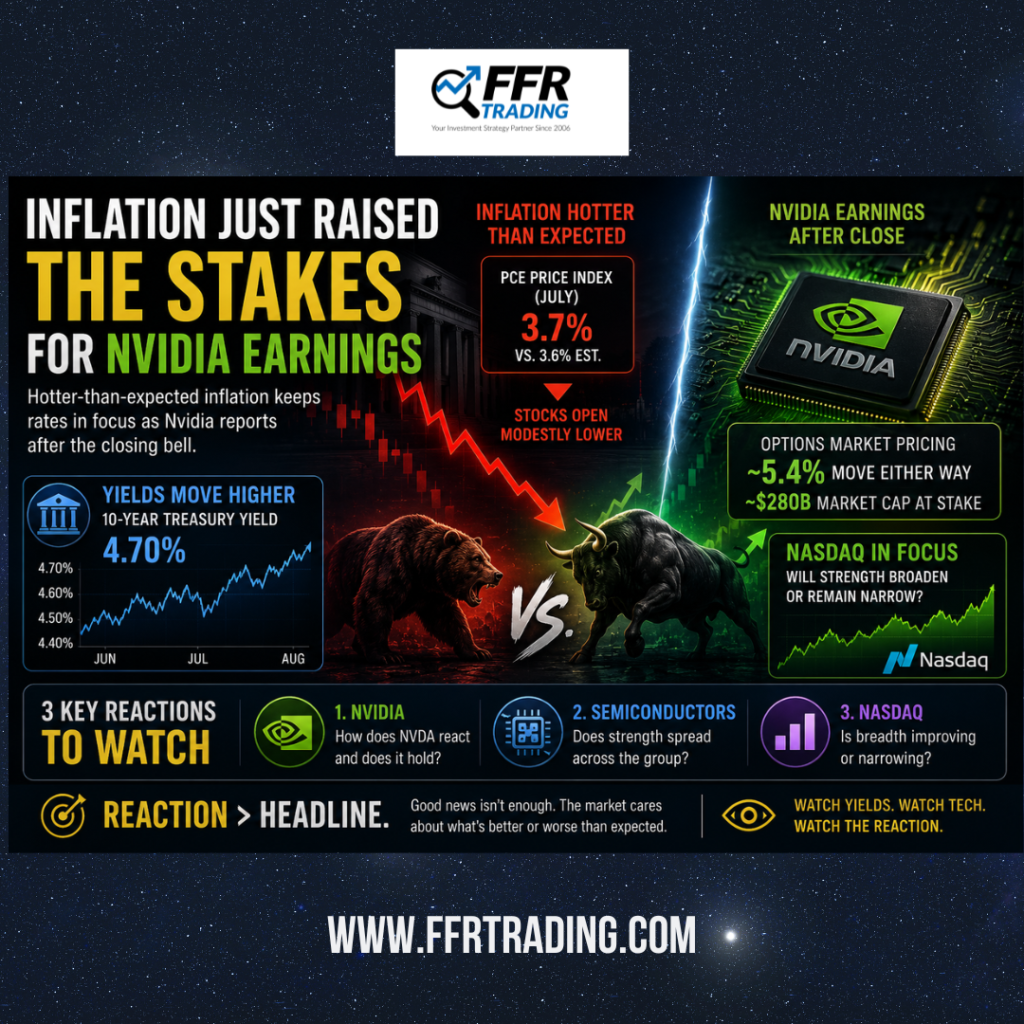
Fresh inflation data came in slightly hotter than expected this morning, putting renewed attention on interest rates and Treasury yields. The S&P 500 and Nasdaq opened modestly lower as traders reassessed the likelihood of another Federal Reserve rate hike.
But the day’s biggest test may still be ahead.
Nvidia reports earnings after today’s closing bell.
And the combination provides traders with an excellent example of why markets should be viewed as a collection of competing forces—not simply a series of headlines.
Inflation Isn’t Falling Fast Enough
The Federal Reserve’s preferred inflation measure, the Personal Consumption Expenditures Price Index, rose 3.7% from a year earlier in July, unchanged from June.
That’s still well above the Fed’s long-term 2% inflation target.
The issue for stocks isn’t simply that inflation remains elevated.
It’s what persistent inflation could mean for interest rates and Treasury yields.
If investors believe the Fed may need to keep monetary policy tighter—or potentially raise rates again—bond yields can move higher.
And as we discussed in Tuesday’s Trading 101 article, higher yields can create a particular challenge for expensive growth stocks.
Now Nvidia Gets Its Turn
That’s what makes tonight’s Nvidia earnings particularly interesting.
Nvidia has become one of the market’s most important gauges of artificial-intelligence spending.
Investors will be watching for clues about AI infrastructure demand, the rollout of the company’s Rubin chips, margins and future guidance. Reuters reports that options traders are pricing in roughly a 5.4% move in Nvidia shares following earnings, representing approximately $280 billion in market value in either direction.
But there’s another important issue:
Expectations are already extremely high.
The question isn’t simply whether Nvidia reports good numbers.
The question is whether those numbers are good enough to exceed what investors have already priced into the stock.
Three Reactions Traders Should Watch
Instead of trying to predict Nvidia’s earnings, consider watching three things after the announcement.
1. Nvidia’s Initial Reaction
Does the stock rise or fall?
More importantly, does that initial reaction hold?
A stock that initially gaps higher but quickly gives back its gains can tell a very different story than one that opens higher and attracts continued buying.
2. Semiconductor Stocks
Nvidia doesn’t trade in isolation.
Watch how other semiconductor and AI-related stocks respond.
If Nvidia rallies but the broader semiconductor group doesn’t participate, the move may be narrower than the headline suggests.
If strength spreads throughout the group, that could provide stronger evidence of renewed AI leadership.
3. The Nasdaq
Finally, watch the broader technology market.
Nvidia has become large enough that its movement can influence the major indexes.
But market breadth still matters.
A healthier reaction would likely involve participation from multiple technology stocks rather than Nvidia carrying the Nasdaq by itself.
Good News Isn’t Enough
This week’s market provides an important trading lesson.
Markets don’t simply ask:
Was the news good or bad?
They ask:
Was it better or worse than expected?
Inflation can remain elevated and stocks can rally if investors expected something worse.
Nvidia can report extraordinary growth and its stock can fall if traders expected even more.
That’s why attempting to predict every economic report or earnings announcement can be so difficult.
There’s another approach:
Let the market show you what matters.
Reaction > Headline
We’ve been emphasizing this principle throughout the week, and today may provide the perfect real-world example.
We now know what the inflation report said.
Next comes Nvidia.
Rather than guessing what the company will report tonight, watch what investors do with the information tomorrow.
Watch Nvidia.
Watch semiconductors.
Watch Treasury yields.
Watch the Nasdaq.
And watch whether participation broadens or narrows.
Because ultimately, the market’s reaction can tell traders considerably more than the headline itself.
Trader’s Takeaway
Don’t try to predict Nvidia’s earnings.
Build a plan for what you’ll watch after the numbers arrive.