

The Lowe’s stock pullback following its latest earnings report may have caught some investors by surprise.
After all, Lowe’s Companies Inc. reported earnings per share of $3.03, beating expectations by six cents. Revenue came in at $23.1 billion, up 10.4% year over year, and ahead of estimates by approximately $220 million.
Comparable sales also climbed 0.6%, suggesting that demand for home improvement products and projects remains more resilient than many expected.
That’s especially notable considering the continued pressure from elevated interest rates, cautious consumers, and a housing market that has remained slower than normal due to affordability challenges.
Yet despite the earnings and revenue beat, LOW stock slipped after the report.
So, what happened?
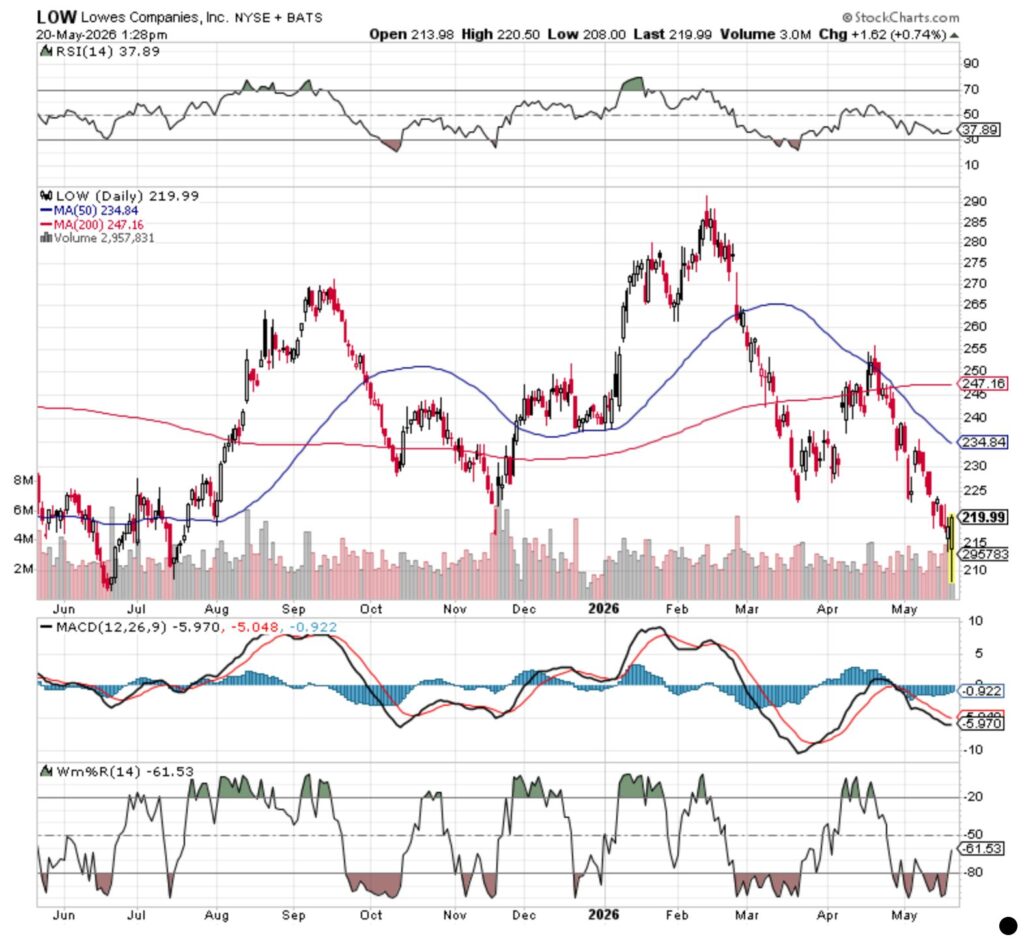
Why Lowe’s Stock Pulled Back
The issue appears to be guidance.
Lowe’s now expects adjusted diluted earnings per share for the year to range between $12.25 and $12.75. While that is still a healthy profit outlook, the midpoint of that range came in slightly below Wall Street’s consensus estimate of $12.59.
That was enough to disappoint investors who were hoping for a stronger full-year outlook, especially after Lowe’s delivered a solid quarterly beat.
In other words, the company’s most recent numbers looked strong — but the market was focused on what comes next.
And when investors don’t like the forward guidance, even a good earnings report can lead to selling pressure.
Why Investors Should Not Write Off Lowe’s Yet
While the post-earnings reaction may look discouraging, investors may not want to write off Lowe’s just yet.
For one, the recent selling pressure has pushed the stock into technically oversold territory.
Momentum indicators such as the Relative Strength Index, MACD, and Williams’ %R suggest that LOW may have fallen too far, too fast.
That doesn’t guarantee an immediate rebound, but it does suggest the stock may be nearing an area where traders begin watching for a potential reversal.
For technically focused traders, oversold readings can be an important signal. They may indicate that selling momentum is starting to become stretched, especially when the underlying company remains fundamentally sound.
Home Improvement Demand Could Improve in 2026
Another reason LOW may be worth watching is the longer-term outlook for the home improvement sector.
The housing market has been under pressure for several years, largely due to elevated mortgage rates and reduced home turnover. When fewer people move, there are often fewer major renovation projects, upgrades, and home improvement purchases.
However, that may be creating pent-up demand.
If interest rates begin to ease and existing home sales gradually improve, homeowners may become more willing to spend on renovations, repairs, upgrades, and delayed improvement projects.
That could benefit major home improvement retailers such as Lowe’s.
According to Citi analysts, the housing and home improvement market could see gradual improvement throughout 2026. Citi recently upgraded Lowe’s to a buy rating after the latest pullback, arguing that much of the bad news may already be priced into the stock.
The firm noted that even if growth remains modest, there is still meaningful pent-up demand for home improvement spending as existing home sales improve and lower rates encourage greater project activity.
The Bigger Picture for LOW Stock
The key question now is whether Lowe’s recent pullback is a warning sign — or an opportunity.
On the bearish side, investors are still dealing with several headwinds:
- High interest rates
- A cautious consumer
- Slower housing turnover
- Softer guidance
- Uncertainty around future home improvement demand
Those are real concerns.
But on the bullish side, Lowe’s still delivered a quarterly earnings and revenue beat. Comparable sales remained positive. The company remains highly profitable. And technical indicators suggest the stock may now be oversold after the recent selling pressure.
That combination may put LOW on the radar for traders looking for potential bounce-back candidates.
Ian Cooper’s Take
Ian Cooper is an experienced trader who uses a combination of technical, fundamental, and news analysis to help individual investors identify market opportunities.
With Lowe’s, the setup is interesting because it combines all three elements:
Fundamentally, the company beat expectations.
Technically, the stock appears oversold.
From a news perspective, analysts are beginning to see signs that the home improvement market could gradually improve in 2026.
That does not mean LOW is guaranteed to rally. But it does mean the stock may deserve a closer look after the recent pullback.
Bottom Line
The Lowe’s stock pullback may look disappointing at first glance, especially after the company posted stronger-than-expected earnings and revenue.
But the selling appears to be tied more to guidance concerns than a major deterioration in the business.
For traders and investors, the key takeaway is this:
LOW may be under pressure now, but the stock could be technically oversold at a time when analysts are beginning to turn more constructive on the home improvement sector.
As always, risk management matters. Oversold stocks can always become more oversold. But for traders watching for potential rebound opportunities, Lowe’s may be one to keep on the radar.
About Ian Cooper
Ian Cooper is an experienced trader who uses a combination of technical analysis, fundamental research, and market-moving news to help individual investors identify potential opportunities in the stock and options markets.
Through Ian Cooper’s Premium Options Strategies, traders can follow Ian’s market insights, trade ideas, and analysis designed to help them better navigate today’s fast-moving markets.
Risk Disclosure: Trading stocks and options involves substantial risk and is not suitable for all investors. Past performance is not indicative of future results. This article is for educational and informational purposes only and should not be considered investment advice or a recommendation to buy or sell any security. Always consult with a qualified financial professional before making investment decisions.