
Nvidia faced enormous expectations Wednesday night.
It delivered.
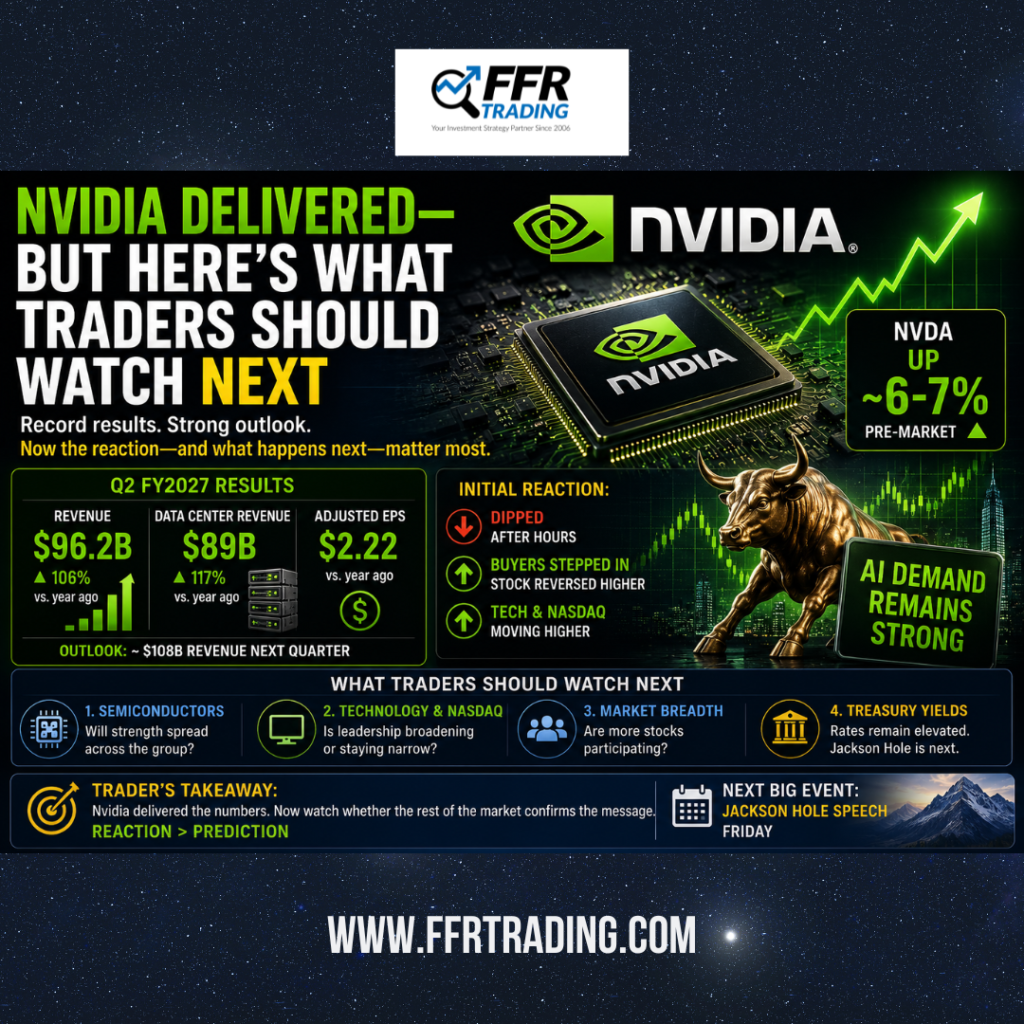
The AI chip leader reported quarterly revenue of $96.2 billion, up 106% from a year earlier. Data Center revenue reached $89 billion, up an extraordinary 117% year over year. Adjusted earnings came in at $2.22 per share.
Even more important, Nvidia’s outlook suggested that demand for artificial-intelligence infrastructure isn’t slowing anytime soon.
Shares surged Thursday morning, helping lift technology stocks and Nasdaq futures.
But rather than simply celebrating another Nvidia earnings beat, traders can learn something more useful from what happens next.
Expectations Matter as Much as Earnings
Nvidia’s results provide a perfect example of something we’ve emphasized throughout earnings season:
Great earnings don’t automatically equal a higher stock price.
Initially, Nvidia shares actually dipped following the report before reversing higher as investors digested the results and management’s outlook.
Why?
Because investors weren’t simply asking whether Nvidia had a good quarter.
They were asking:
Was it good enough?
That’s an important distinction when expectations surrounding a company are extremely high.
AI Demand Remains Remarkably Strong
The numbers suggest that the AI infrastructure boom remains very much alive.
Nvidia’s Data Center business generated $89 billion in quarterly revenue, while the company forecast approximately $108 billion in revenue for the current quarter.
CEO Jensen Huang also indicated that demand continues to exceed available supply as AI moves beyond experimentation and toward broader real-world deployment.
That’s significant for Nvidia.
It could have implications for semiconductor companies, data-center operators, networking companies, power infrastructure providers and other businesses connected to AI spending.
Now Watch Whether the Strength Spreads
This is where traders should pay close attention.
Nvidia rising is one thing.
The rest of the market following Nvidia higher is something different.
Watch semiconductor stocks.
Watch other AI-related companies.
Watch the Nasdaq.
And watch market breadth.
If Nvidia’s results encourage buying throughout the technology sector, that would provide stronger evidence that investors remain willing to embrace the broader AI trade.
If Nvidia surges while much of technology struggles, however, the message becomes considerably more mixed.
There’s Still Another Variable: Treasury Yields
Strong earnings don’t eliminate the interest-rate issue we’ve discussed this week.
Treasury yields remain elevated, and investors are now turning their attention toward Friday’s Jackson Hole speech from Federal Reserve Chair Kevin Warsh.
That means two powerful forces remain in play:
AI earnings growth is providing a potential tailwind.
Higher interest rates remain a potential headwind.
Which one matters more could help determine whether technology’s rebound develops into something larger.
What Traders Can Learn From Nvidia
There’s a broader lesson here.
Going into Wednesday’s report, traders could have spent hours trying to predict Nvidia’s revenue, earnings, guidance and after-hours move.
But they didn’t need to.
Once the information arrived, the market began telling us what mattered.
The stock initially dipped.
Then buyers stepped in.
Other AI-related stocks began responding.
Nasdaq futures moved higher.
That’s useful information.
And it reinforces one of the principles we’ve been emphasizing all week:
Reaction > Prediction
You don’t have to correctly forecast every earnings report.
Sometimes the better approach is to wait for the information, observe how investors respond, and then determine whether the reaction confirms—or contradicts—the prevailing market trend.
Trader’s Takeaway
Nvidia delivered the numbers.
Now watch whether the rest of the market confirms the message.
If strength spreads across semiconductors, technology and the broader market, the AI trade may have another important tailwind.
If participation remains narrow, that’s information too.