
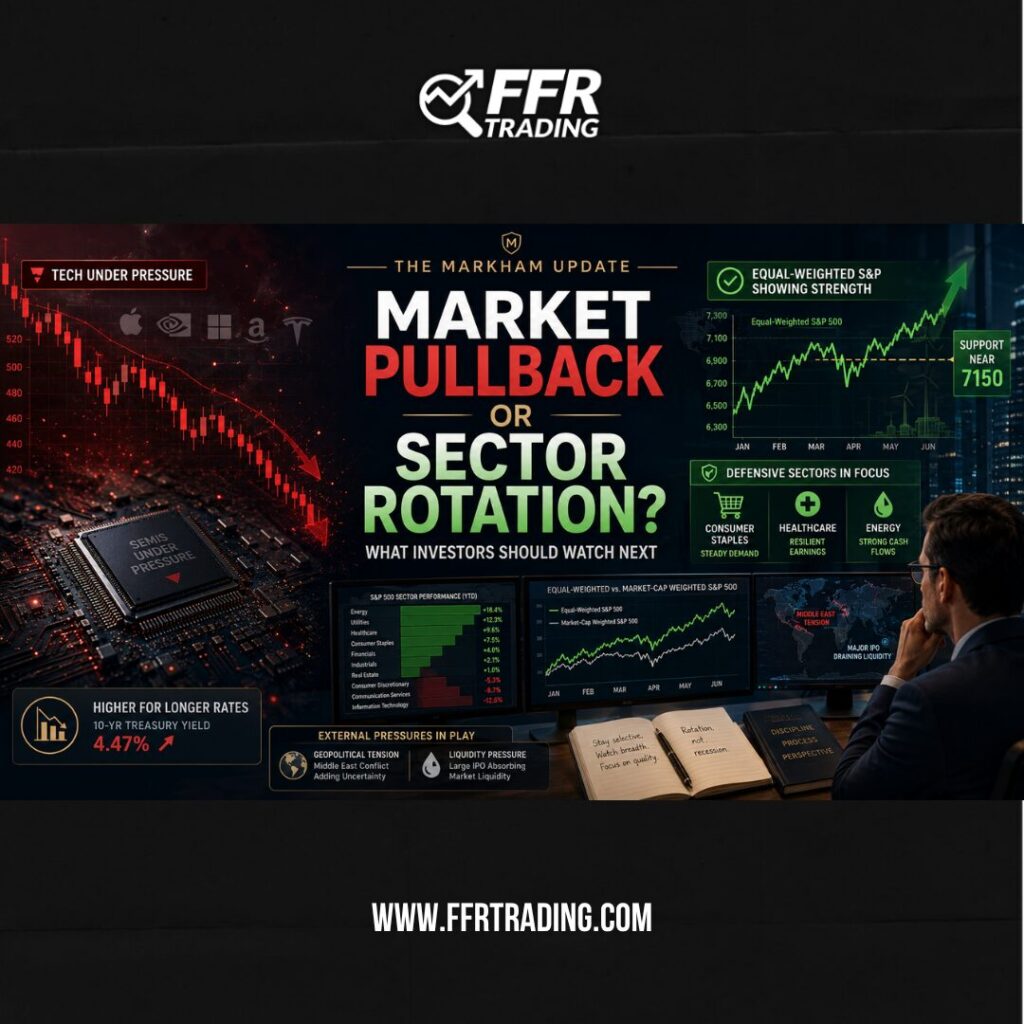
Is this a market pullback or sector rotation? That is the key question investors are asking after a sharp move lower followed an impressive momentum run where the S&P 500 climbed for nearly 10 consecutive weeks.
While pullbacks can feel uncomfortable, they are not always a sign of a broken market. In fact, after an extended rally, a 5% to 7% correction can be both normal and necessary. It gives the market a chance to reset, cool off overbought conditions, and reveal where true strength still exists.
Right now, the evidence suggests this may be more about rotation than broad market weakness.
Market Pullback or Sector Rotation: Why Tech Is Taking the Hit
The current pullback is primarily hitting the same areas that carried the market higher during the recent rally: technology, semiconductors, software, and other high-growth leaders.
That makes sense.
When a rally becomes heavily concentrated in a handful of major tech names, those stocks often become the first source of selling when investors decide to take profits, raise cash, or reduce risk.
This does not necessarily mean the long-term technology or artificial intelligence story is over. It simply means many of these stocks had become extended and were due for a reset.
For traders, this is an important reminder: even the strongest stocks can pull back sharply when momentum gets stretched.
Why This May Be Sector Rotation, Not a Breakdown
Despite the weakness in tech, the broader market remains more constructive than the headline indexes may suggest.
One encouraging sign is the performance of the equal-weighted S&P 500. As of Wednesday’s close, the equal-weighted index was only about 2% off its highs, showing stronger performance than the cap-weighted indexes that are more heavily dominated by mega-cap technology stocks.
You can track the S&P 500 Equal Weight Index through S&P Global here: https://www.spglobal.com/spdji/en/indices/equity/sp-500-equal-weight-index/
That matters.
If the market were experiencing a broad-based selloff, we would expect weakness to spread across most sectors. Instead, capital appears to be rotating out of crowded tech names and into other areas of the market.
This type of rotation can actually help keep the broader uptrend intact.
Rather than a market that is breaking down, this may be a market that is broadening out.
Key Support in This Market Pullback
From a technical perspective, the broader index uptrend remains intact as long as key support levels continue to hold.
The charts currently point toward important support around the 7150 level. If buyers step in near that area, it would suggest the market is absorbing the pullback in a constructive way.
However, if that support fails, traders should become more cautious.
Support levels are important because they show where buyers have previously stepped in. If those buyers return, the market may stabilize. If they do not, selling pressure could build.
For now, the pullback appears sharp, but still consistent with a normal market correction after a strong run.
Investors can compare broader index trends using S&P Global’s S&P 500 index information here: https://www.spglobal.com/spdji/en/indices/equity/sp-500/
SpaceX IPO Liquidity May Be Pressuring Tech
One unique factor weighing on the market is the massive SpaceX IPO.
With the deal reportedly four times oversubscribed, investors may be raising cash to participate. That can create short-term liquidity pressure, especially in the stocks that have already produced large gains.
Technology stocks are a natural source of cash in that environment.
When investors need liquidity, they often sell what has worked. That does not mean those stocks are permanently broken, but it can create pressure in the short term.
This may help explain why semiconductors, software, and other major tech leaders are seeing outsized selling pressure during this pullback.
Higher for Longer Rates Remain a Key Risk
Inflation and interest rates are also key parts of the current market picture.
Recent economic reports, combined with firm oil prices, suggest inflation may remain sticky. That raises the possibility that interest rates stay higher for longer than many investors had hoped.
Higher rates can create problems for certain areas of the market, especially high-growth stocks and interest-rate-sensitive sectors.
Investors can follow Federal Reserve monetary policy updates here: https://www.federalreserve.gov/monetarypolicy.htm
That is why traders should not only look for potential long opportunities in defensive sectors, but also remain alert for short-term bearish setups in areas most vulnerable to higher rates.
Energy, Oil Prices, and Defensive Sector Rotation
The market is also dealing with renewed geopolitical tension tied to Iran.
Geopolitical risk can create sudden volatility because it is difficult for investors to price. When uncertainty rises, markets often react quickly as traders reduce exposure and move toward sectors perceived as more defensive.
That has helped put energy back in focus.
Oil prices remain stubborn, and if geopolitical tensions continue, energy stocks could benefit from supply concerns and higher crude prices.
Investors can monitor U.S. oil and petroleum data through the U.S. Energy Information Administration here: https://www.eia.gov/petroleum/
In this environment, investors may want to focus on sectors that can hold up better during uncertainty. Consumer Staples, Healthcare, and Energy all deserve attention.
Consumer Staples can attract capital when investors want stability. Healthcare often performs better during periods of economic uncertainty because demand is less tied to the business cycle. Energy may benefit from geopolitical risk, supply concerns, and firm oil prices.
Bottom Line: Market Pullback or Sector Rotation?
The big question remains: is this a market pullback or sector rotation?
Right now, the answer may be both.
The market is undergoing a sharp but necessary pullback after a strong momentum run. Tech is taking the biggest hit, but beneath the surface, the market remains more constructive than the headlines may suggest.
The equal-weighted S&P 500 continues to show relative strength, indicating that capital may be rotating rather than leaving the market entirely.
That distinction matters.
If the market holds key support and leadership continues to broaden, this pullback could become a healthy reset. But if support breaks, geopolitical risk escalates, or interest rates continue to pressure growth stocks, volatility could continue.
For now, investors should focus on three things:
Watch support.
Follow the rotation.
Stay disciplined.
This is a market that rewards selectivity, not emotion.
About Blane Markham
Blane Markham is a market analyst and trading strategist with the Markham Group, where he focuses on identifying high-quality technical setups across leading stocks and sectors. His analysis combines trend strength, momentum, sector leadership, and disciplined risk management to help traders better navigate changing market conditions.