
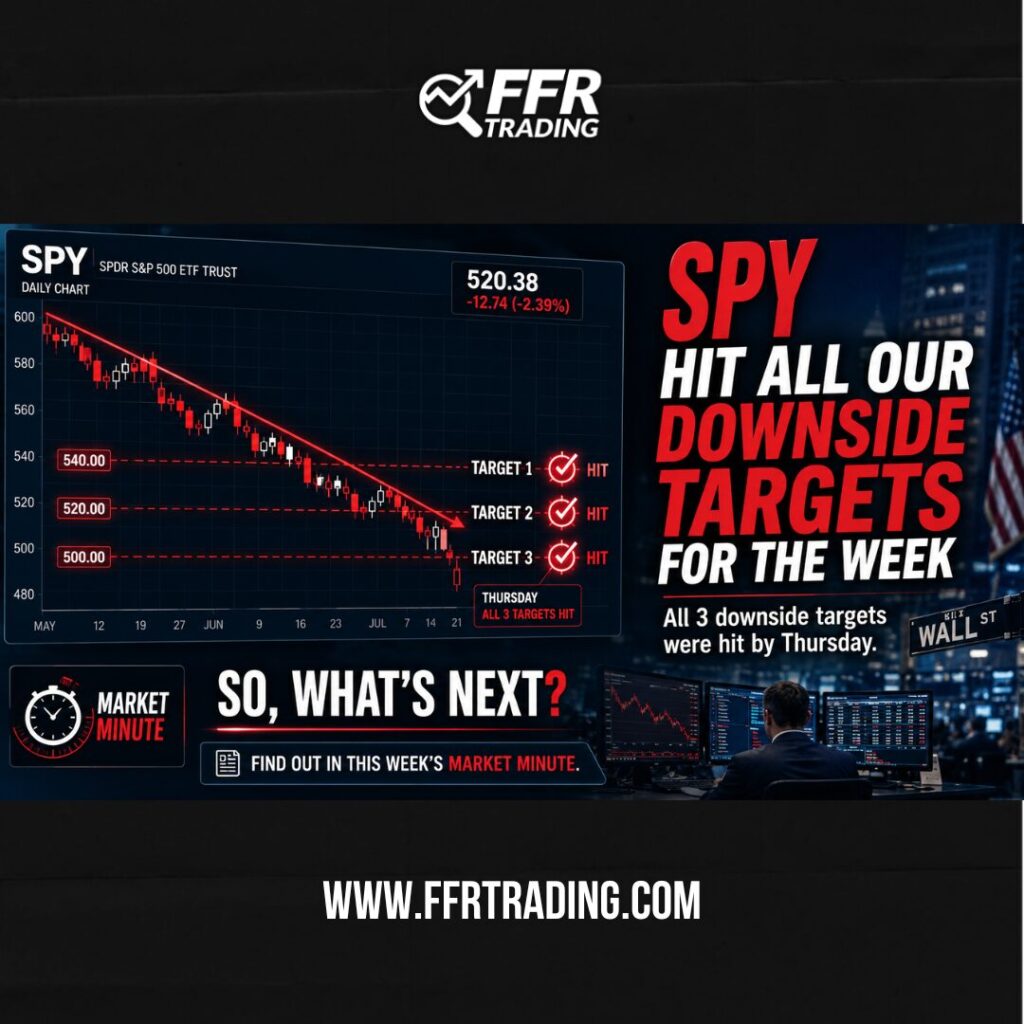
The pullback we were watching for in SPY has officially arrived.
Earlier this week, we laid out three downside targets for the SPDR S&P 500 ETF Trust (NYSE: SPY), and by Thursday, all three of those targets had been hit. After a strong momentum run, the market finally started to cool off, and the selling pressure came in quickly.
That does not mean the market is broken.
But it does mean traders need to pay close attention to what happens next.
The SPY Pullback Played Out as Expected
Markets rarely move in a straight line forever.
After an extended rally, SPY had become stretched in the short term. When stocks run too far, too fast, a pullback often becomes necessary. These types of corrections can help reset momentum, reduce overbought conditions, and give traders a better read on where buyers may step back in.
This week, SPY followed the downside path we were watching.
The first target was hit.
Then the second target was hit.
By Thursday, the third downside target had also been reached.
That is important because it means the market has now completed the initial downside move we were expecting.
Now the question becomes whether SPY can stabilize — or whether the selloff has more room to run.
What Traders Should Watch Next
Once downside targets are reached, traders should avoid assuming the market will automatically bounce.
Sometimes, hitting downside targets leads to a relief rally. Other times, selling pressure continues as momentum shifts lower and weak hands continue to exit.
The key now is to watch how SPY behaves around these lower levels.
If buyers begin stepping in, we could see a short-term rebound attempt. That would be a constructive sign, especially if volume improves and leadership begins to broaden beyond just a few major stocks.
But if SPY fails to hold support and selling pressure accelerates, traders should stay cautious. A deeper pullback could develop if momentum remains negative.
Is This a Healthy Reset?
So far, this still looks like a normal market reset after a strong move higher.
A healthy pullback can actually be a good thing. It gives the market a chance to digest gains and allows traders to separate strong stocks from weak ones.
The strongest stocks are often the ones that hold up best during market weakness. The weakest stocks usually break support first.
That is why this type of environment can be useful for traders. It reveals where relative strength still exists and where risk may be increasing.
Sector Rotation Matters
One of the biggest things to watch now is sector rotation.
If money continues to move out of overheated areas and into other sectors, the broader market may remain constructive even if SPY stays under short-term pressure.
However, if selling spreads across the entire market and defensive areas fail to hold up, that would be a more concerning development.
In other words, the index level matters — but market participation matters too.
Traders should watch whether capital is rotating or simply leaving the market altogether.
Bottom Line
SPY hit all three of our downside targets for the week by Thursday.
That confirms the pullback we were expecting, but it also creates a new decision point for traders.
Now we want to see whether SPY can stabilize, build support, and set up for a possible bounce — or whether continued selling pressure opens the door to another move lower.
The market has reached our downside targets.
Now comes the more important question:
What happens next?
Find out in this week’s FFR Trading Market Minute.