
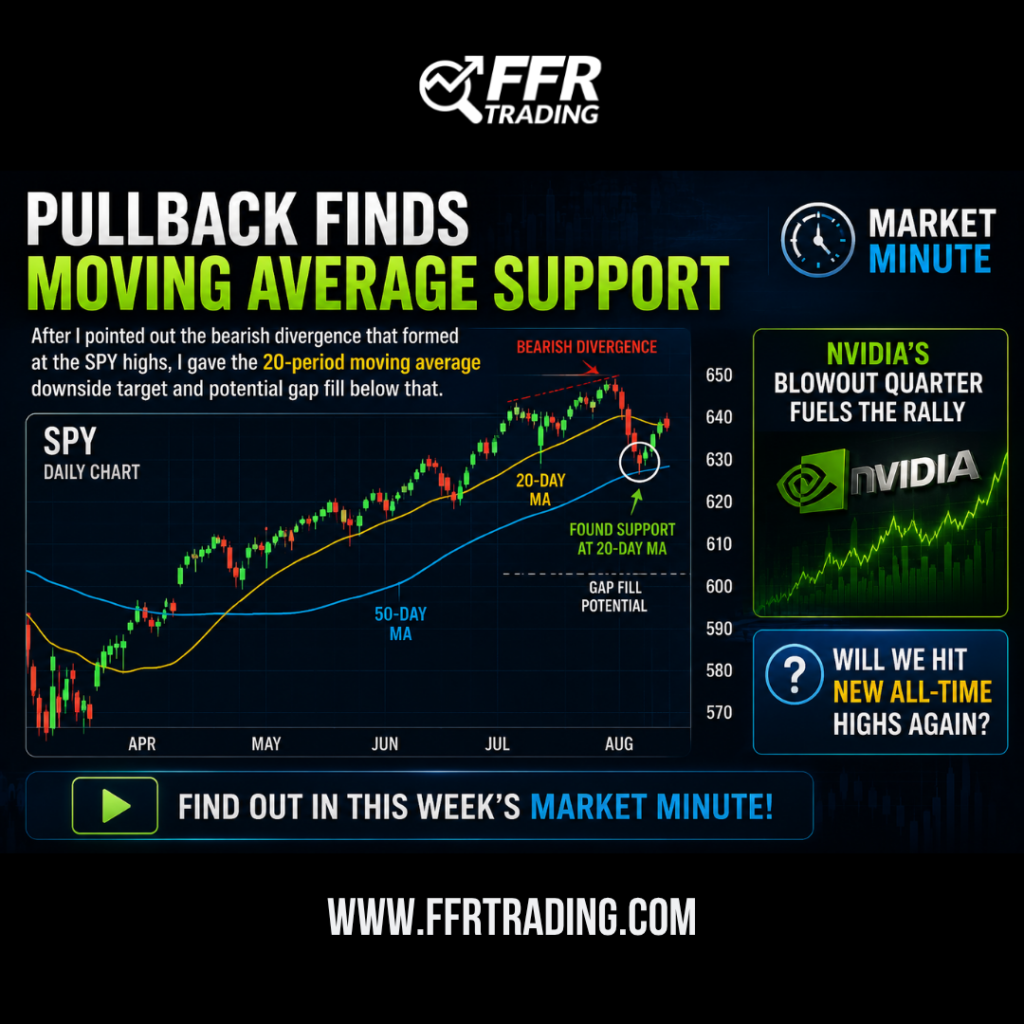
The recent SPY pullback found moving average support almost exactly where traders had reason to watch for buyers.
After the SPY pushed to new all-time highs, momentum began showing signs of weakening. A bearish divergence developed near the highs, creating the possibility of a pullback toward the 20-day moving average and potentially the open gap below it.
The pullback arrived—but buyers stepped in around the 20-day moving average before the market could extend significantly lower.
Now SPY is rallying again, helped by Nvidia’s powerful post-earnings move. The S&P 500 gained 0.7% Thursday while the Nasdaq jumped 1.6%, as Nvidia and other technology stocks helped lead the rebound.
That raises the obvious question:
Is the pullback over—and are new all-time highs next?
Why the 20-Day Moving Average Matters
Moving averages aren’t magical support levels.
But they can help traders identify areas where buyers and sellers have previously responded to price.
The 20-day moving average is particularly useful for evaluating shorter-term trends. When a market is trending higher, a pullback toward a rising 20-day average can sometimes attract buyers looking for an opportunity to participate in the larger trend.
That’s essentially what we’ve just seen in SPY.
Price pulled back from the highs, tested the moving-average area and then began recovering.
The important question now isn’t whether the moving average worked.
It’s whether buyers can build on that support.
What Happened to the Bearish Divergence?
The original warning came from a bearish divergence near the SPY highs.
A bearish divergence occurs when price reaches a higher high while a momentum indicator fails to confirm that strength.
It doesn’t automatically mean the market is about to crash.
Instead, think of divergence as a warning rather than a prediction.
Momentum was telling us the rally was becoming less convincing.
In this case, that warning was followed by a pullback toward the 20-day moving average.
That’s an important distinction for traders.
A bearish divergence doesn’t necessarily signal the end of a bull market. Sometimes it simply precedes the type of short-term correction needed to reset momentum before another attempt higher.
Nvidia Gives the Rebound a Powerful Catalyst
The timing of Nvidia’s earnings couldn’t have been much better for technology bulls.
Nvidia reported quarterly revenue of $96.2 billion, up 106% year over year, while Data Center revenue surged 117% to $89 billion.
Nvidia’s official Q2 FY2027 results
Investors responded enthusiastically. Nvidia surged following the report, helping lift technology and semiconductor stocks and providing another catalyst for the broader market rebound.
But one company’s earnings report doesn’t determine the market’s next move.
That’s where the technical picture becomes important again.
What SPY Needs to Do Next
The next test is relatively straightforward.
Can SPY reclaim its previous highs and hold above them?
A move back toward the highs would put the market in position to challenge resistance. A decisive breakout accompanied by broader participation could provide evidence that the recent pullback was simply a pause within the larger uptrend.
But traders should also consider the alternative.
If SPY approaches its previous highs and sellers return, we could see another attempt to establish resistance.
And if the market loses the 20-day moving average again, attention could shift back toward the lower gap area that we were watching during the original pullback.
In other words, there are now clearly defined areas to watch on both sides.
Don’t Ignore Market Breadth
There’s another piece of the puzzle.
A new SPY high becomes more convincing when more stocks participate.
If the index reaches a record primarily because Nvidia and a handful of mega-cap technology companies are surging, the rally may be less robust than the headline suggests.
If semiconductors, financials, industrials, small caps and other groups begin participating, that would suggest broader buying underneath the index.
So don’t watch SPY alone.
Watch what’s happening inside the market.
Moving Average Support Is a Clue—Not a Guarantee
The recent SPY pullback finding moving average support is constructive.
Nvidia’s earnings have provided another catalyst.
And buyers have responded.
But none of those factors guarantees new highs.
The next few trading sessions should tell us whether the 20-day moving average marked the end of this pullback—or simply a temporary pause before another test lower.
That’s why traders don’t need to predict the answer.
We can watch the evidence.
20-day moving average holds + previous highs break + participation broadens: increasingly constructive.
Previous highs reject price + momentum weakens + 20-day support fails: reason for additional caution.
Trader’s Takeaway
The bearish divergence warned us that momentum was weakening.
The 20-day moving average gave us an area to watch for support.
Now price is giving us the next piece of information.
Watch whether buyers can turn that support into a breakout.
That will tell us considerably more than trying to predict whether SPY should make another all-time high.