
The stock market outlook is entering an important period as investors prepare for a combination of major corporate earnings and fresh inflation data.
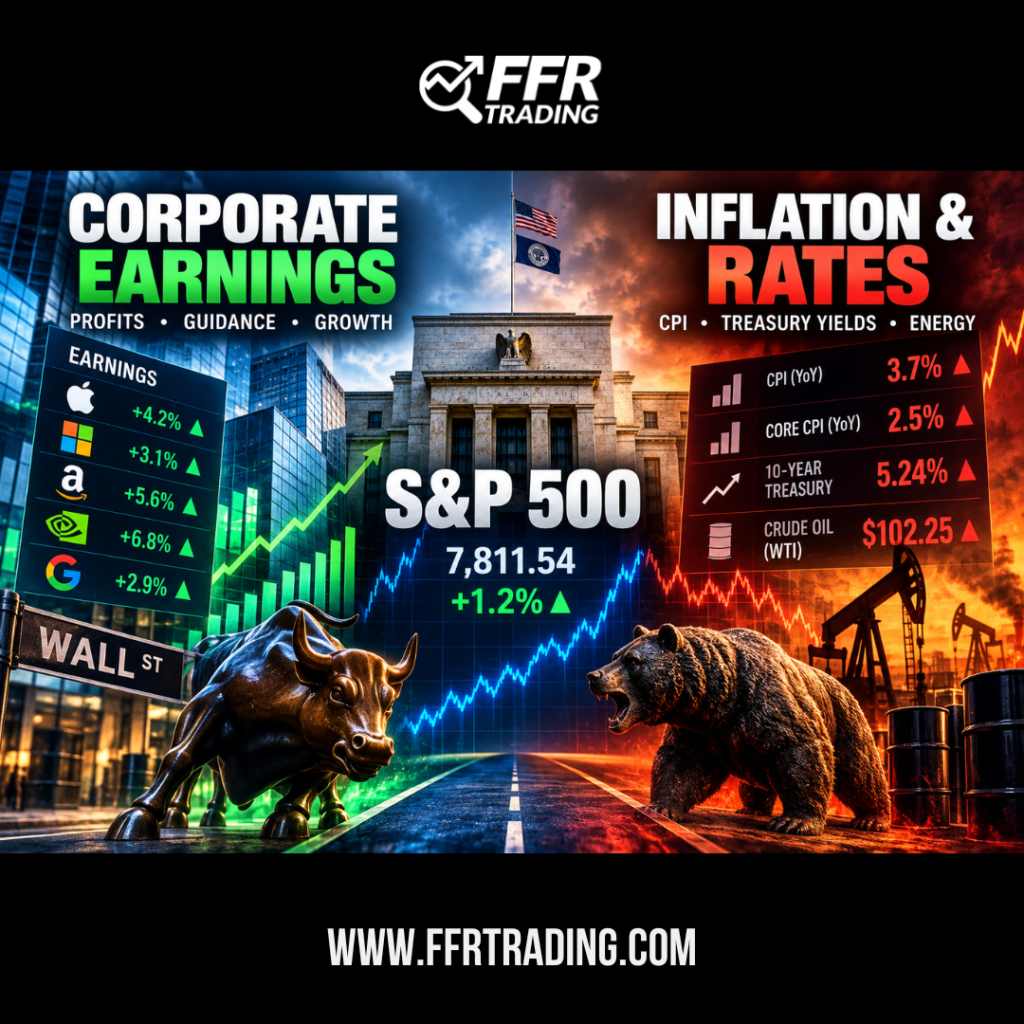
The S&P 500 finished Friday at 7,811.54, gaining approximately 1.2% for the week and remaining close to record territory.
The Nasdaq also advanced, although smaller companies continued to lag the broader market.
That leaves traders with an interesting question.
Can corporate earnings provide enough support to overcome persistent inflation and elevated interest rates?
This week’s economic calendar could provide important clues.
Earnings Season Begins With the Banks
Some of the largest financial institutions in the United States will report third-quarter earnings this week.
Bank earnings deserve attention because financial institutions occupy a unique position in the economy.
They provide insight into lending activity, consumer credit, business borrowing, and capital-market conditions.
Strong results could reinforce the argument that the economy remains resilient despite higher interest rates.
But disappointing results, particularly those involving loan losses or weakening consumer finances, could raise concerns.
According to Reuters, the S&P 500 banking index declined approximately 7.5% over the month leading into earnings season.
That makes the market’s reaction to bank earnings especially interesting.
Will investors respond positively to stronger-than-expected results?
Or will concerns about credit quality and future economic conditions outweigh headline earnings?
Inflation Could Complicate the Picture
Wednesday’s Consumer Price Index is likely to be one of the week’s most closely watched economic releases.
Economists expect headline inflation to rise approximately 3.7% year over year, according to a Reuters survey.
Core inflation, which excludes food and energy, is expected to increase approximately 2.5%.
These are forecasts, not reported results.
If inflation exceeds expectations, investors may increase their estimates for how aggressively the Federal Reserve needs to respond.
That could put upward pressure on Treasury yields.
And higher yields can create difficulties for stocks.
Why Treasury Yields Matter
The benchmark 10-year Treasury yield finished last week near 5.24%.
That’s an important development because Treasury yields influence borrowing costs and investment decisions throughout the economy.
Higher yields can make bonds more attractive relative to equities.
They can also increase borrowing costs for corporations and consumers.
Growth stocks can be especially sensitive because their valuations often depend heavily on expected future earnings.
But higher yields don’t automatically mean stocks must decline.
The more useful question is whether corporate earnings growth remains strong enough to justify current valuations.
Three Things Traders Should Watch
1. S&P 500 support and resistance
The S&P 500 remains near its recent highs.
Traders should identify the most recent breakout area, the 20-day moving average, and nearby support levels.
A sustained move above resistance with expanding participation would strengthen the bullish technical picture.
A failed breakout accompanied by weakening breadth could signal a more cautious environment.
2. Bank earnings and market reaction
Don’t simply focus on whether banks beat earnings estimates.
Pay attention to loan-loss provisions, management guidance, consumer credit trends, and the stocks’ reactions.
A company can report better-than-expected earnings and still decline if investors are disappointed with its outlook.
3. Treasury yields following CPI
Wednesday’s inflation report could influence the direction of interest rates.
If yields rise sharply, watch whether technology stocks and the broader market begin struggling.
If yields retreat, that could provide some relief for rate-sensitive sectors.
A Trading Lesson From Earnings Season
Earnings season provides an excellent opportunity to understand the difference between information and expectations.
Suppose a company reports earnings growth of 20%.
That sounds impressive.
But if investors expected 30% growth, the stock could still decline.
Now consider another company reporting a 5% earnings decline.
If Wall Street expected a 15% decline, investors might respond positively.
Markets trade the difference between expectations and reality.
That’s why price reaction matters.
Risk Management During Major Announcements
Economic releases and earnings announcements can produce significant volatility.
For options traders, these events introduce additional considerations.
Implied volatility can increase ahead of an announcement and decline afterward.
That means a trader can correctly anticipate a stock’s direction and still lose money on an options position if the price move is insufficient to overcome premium decay or volatility changes.
Traders should understand their maximum potential loss, position sizing, and exposure to scheduled announcements.
Avoid assuming that a strong directional opinion automatically creates a favorable trade.
FFR Trader’s Tip
This week isn’t simply about whether earnings are good or inflation is bad.
It’s about how investors balance the two.
Strong earnings combined with moderating inflation would provide a more favorable environment.
Disappointing earnings combined with persistent inflation could create greater challenges.
The key is to remain flexible.
Prepare for different outcomes instead of becoming committed to one prediction.
That’s how disciplined traders approach uncertainty.