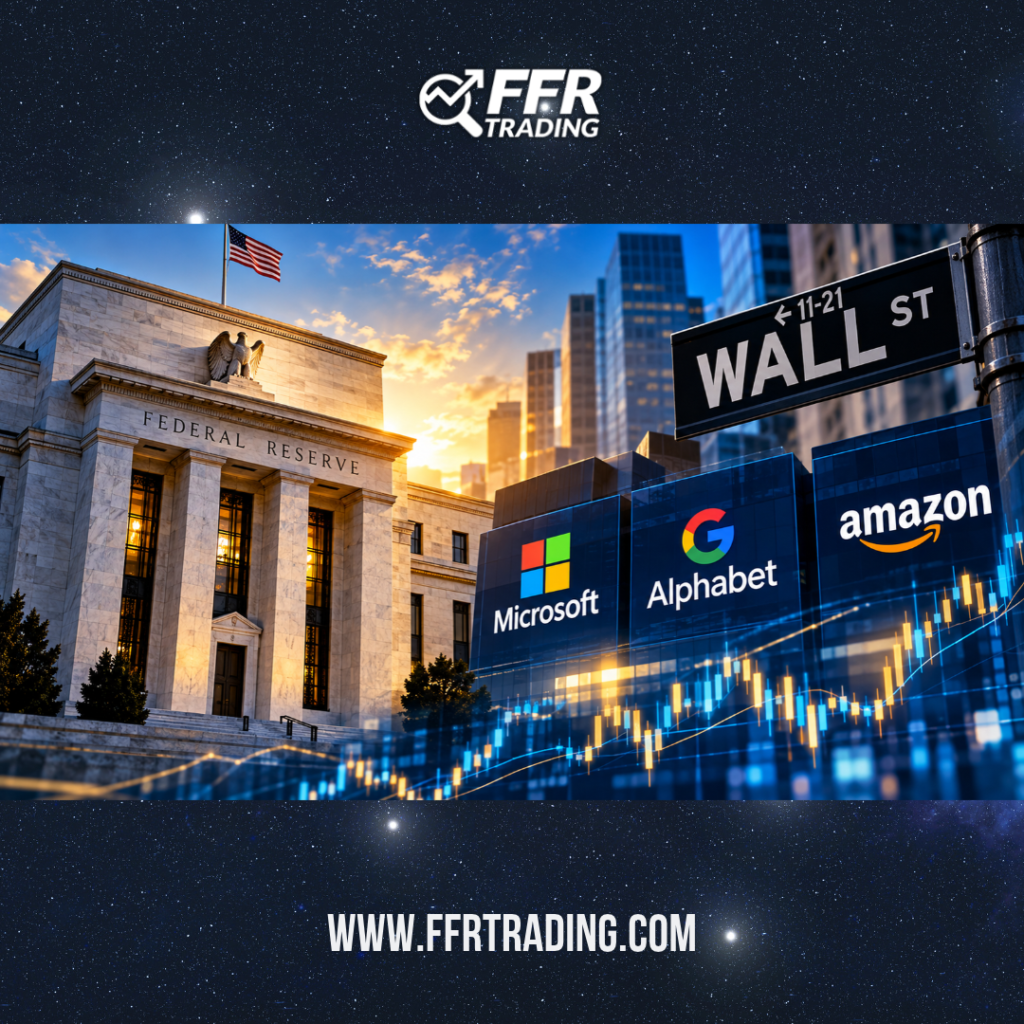
The Fed decision and tech earnings are set to dominate Wall Street this week as investors prepare for a Federal Reserve interest-rate announcement and quarterly results from Microsoft, Alphabet, and Amazon.
With technology stocks facing questions about artificial intelligence spending, elevated borrowing costs, and future profitability, these major announcements could influence the market’s next direction.
The Federal Reserve concludes its two-day meeting Wednesday, October 28, while Microsoft and Alphabet are scheduled to report earnings after the closing bell. Amazon follows Thursday.
Together, these developments will provide investors with important information about interest rates, economic growth, and whether corporate profits can support current stock valuations.
The Federal Reserve Takes Center Stage Wednesday
The Federal Reserve concludes its two-day policy meeting on Wednesday, October 28, with its interest-rate announcement scheduled for 2:00 p.m. Eastern.
While investors are largely anticipating no change in interest rates, the decision itself may not be the most important development.
Instead, traders will be listening closely to the Fed’s accompanying statement and subsequent press conference for clues about future monetary policy.
Several questions remain unanswered:
-
Is inflation cooling quickly enough to justify keeping rates unchanged?
-
Is the labor market slowing enough to concern policymakers?
-
Could elevated energy prices contribute to another round of inflation?
-
How long might borrowing costs remain restrictive?
The answers could influence Treasury yields, stock valuations, and expectations for the Fed’s December meeting.
Why the Fed’s Words Matter More Than Its Decision
Financial markets frequently anticipate Federal Reserve decisions well before they are announced.
Consequently, an expected rate decision may have relatively little impact.
What often moves markets is a change in expectations about future policy.
For example, if policymakers indicate that inflation remains a serious concern, Treasury yields could rise as investors adjust their interest-rate expectations.
That could create additional pressure on growth stocks, particularly companies whose valuations depend heavily on profits expected years into the future.
Conversely, if the Fed signals greater confidence that inflation is easing, investors may become more comfortable with current equity valuations.
Neither reaction is guaranteed. Market positioning and investor expectations can influence the outcome.
Big Tech Faces an Artificial Intelligence Reality Check
Just hours after Wednesday’s Fed announcement, Microsoft and Alphabet are scheduled to report quarterly earnings.
Amazon follows Thursday.
These reports will be especially important because artificial intelligence has become one of the dominant investment themes driving technology stocks.
For several years, investors have rewarded companies announcing major AI initiatives, infrastructure expansions, and data-center investments.
But expectations are evolving.
Investors increasingly want evidence that those investments are generating sustainable revenue, improving productivity, and supporting profitability.
Microsoft: Can AI Spending Deliver Results?
Microsoft has invested heavily in cloud computing and artificial intelligence through Azure, Copilot, and its broader enterprise software ecosystem.
Investors will be watching several important indicators:
-
Azure revenue growth
-
Demand for AI-powered cloud services
-
Capital expenditures
-
Operating margins
-
Management’s outlook for future growth
The challenge is that building AI infrastructure requires substantial investment.
Even when demand is strong, spending on data centers, chips, and computing capacity can affect near-term cash flow.
The question is whether Microsoft’s growing AI business can generate sufficient returns to justify those expenditures.
Alphabet: Can AI Strengthen Google’s Business?
Alphabet faces a somewhat different challenge.
Its Google Search business generates substantial advertising revenue, but AI-powered search tools are changing how people access information.
Investors will be evaluating whether Alphabet can expand its AI capabilities while protecting its existing advertising business.
Google Cloud performance will also be important.
Strong cloud growth could reinforce confidence in AI infrastructure demand, while weaker margins or higher-than-expected spending could raise questions about profitability.
Amazon: AI Meets Consumer Spending
Amazon’s earnings Thursday provide investors with two perspectives on the economy.
First, Amazon Web Services offers another important look at cloud computing and AI demand.
Second, Amazon’s retail business provides insight into consumer spending.
Investors will be watching AWS growth, capital expenditures, operating margins, retail demand, and management’s outlook for the holiday shopping season.
Together, these results could help clarify whether AI investment and consumer spending remain important sources of economic strength.
Why Treasury Yields Matter to Technology Stocks
One of the biggest challenges facing technology stocks is the level of interest rates.
When Treasury yields rise, investors can earn more from relatively lower-risk government securities.
That changes the calculation when evaluating stocks.
Higher interest rates also reduce the present value of expected future earnings, which can place additional pressure on companies trading at elevated valuations.
This is particularly important for growth stocks.
Consider two companies.
One generates substantial profits and cash flow today.
The other is expected to generate most of its profits several years from now.
When interest rates rise, the valuation of the second company may be more sensitive because a larger portion of its estimated value depends on distant future earnings.
This helps explain why technology stocks can experience selling pressure even when their underlying businesses continue growing.
A growing business does not automatically mean a rising stock price.
Valuation and investor expectations matter.
Thursday’s GDP and PCE Reports Add Another Test
The market’s attention won’t be limited to the Fed and corporate earnings.
Thursday brings two important economic reports: third-quarter GDP and September Personal Consumption Expenditures inflation.
GDP measures overall economic activity, while the PCE price index is closely watched by Federal Reserve policymakers.
These reports could provide additional information about the relationship between economic growth and inflation.
Three Scenarios Traders Should Understand
Scenario 1: Strong growth and cooling inflation
This combination could support confidence in the economy while reducing concerns about additional monetary tightening.
Scenario 2: Strong growth and persistent inflation
Economic resilience would be encouraging, but stubborn inflation could keep Treasury yields elevated and limit the Fed’s flexibility.
Scenario 3: Slowing growth and persistent inflation
This would present a more difficult environment because policymakers would be balancing weaker economic activity against continued price pressures.
These are possibilities rather than forecasts. The market’s reaction will depend on how the actual data compares with expectations.
Market Breadth Could Provide Important Clues
While the Fed and technology earnings dominate headlines, traders should also pay attention to what is happening beneath the major indexes.
A rally driven primarily by a handful of large technology companies may look impressive in the S&P 500 or Nasdaq.
However, that doesn’t necessarily mean the broader market is strengthening.
Market breadth measures how many individual stocks are participating in an advance or decline.
Useful indicators include:
-
Advancing stocks versus declining stocks
-
New 52-week highs versus new lows
-
Equal-weight versus capitalization-weighted indexes
-
Russell 2000 performance
-
Sector relative strength
If technology stocks rally following earnings while participation broadens across financials, industrials, healthcare, and smaller companies, that could provide additional confirmation of improving market conditions.
Conversely, if a handful of technology companies lift the major indexes while most stocks struggle, traders may want to remain cautious.
What Traders Should Watch This Week
Rather than attempting to predict the Fed’s announcement or individual earnings results, traders may benefit from monitoring how markets respond.
Wednesday: Watch the reaction to the Fed statement and press conference, particularly in Treasury yields, SPY, and QQQ.
Wednesday evening: Evaluate Microsoft’s and Alphabet’s earnings, guidance, AI spending, and management commentary.
Thursday morning: Compare GDP and PCE inflation with market expectations.
Thursday evening: Watch Amazon’s AWS results, retail performance, and outlook.
Friday: Evaluate whether the market’s reaction is supported by improving breadth, sustained price action, and participation across multiple sectors.
Major announcements can produce sharp price swings and reversals. Traders should consider position sizing, liquidity, and predefined risk limits, particularly around scheduled news releases.
The Bottom Line
The Fed decision and tech earnings could provide valuable information about the stock market’s next phase.
The Federal Reserve will offer insight into the future direction of interest rates, while Microsoft, Alphabet, and Amazon will provide evidence about the financial performance of major AI investments.
Meanwhile, GDP and PCE inflation will help investors evaluate the broader economy.
The important question is not simply whether the news is good or bad.
It’s whether the results are better or worse than investors expected—and how prices respond.
For traders, the most useful approach is to remain flexible, monitor market breadth and key technical levels, and allow price action to confirm whether buyers or sellers are gaining control.
At FFR Trading, we believe understanding the forces driving the market is an important part of making informed trading decisions.
Stay focused, stay disciplined, and remember that preparation matters more than prediction.