
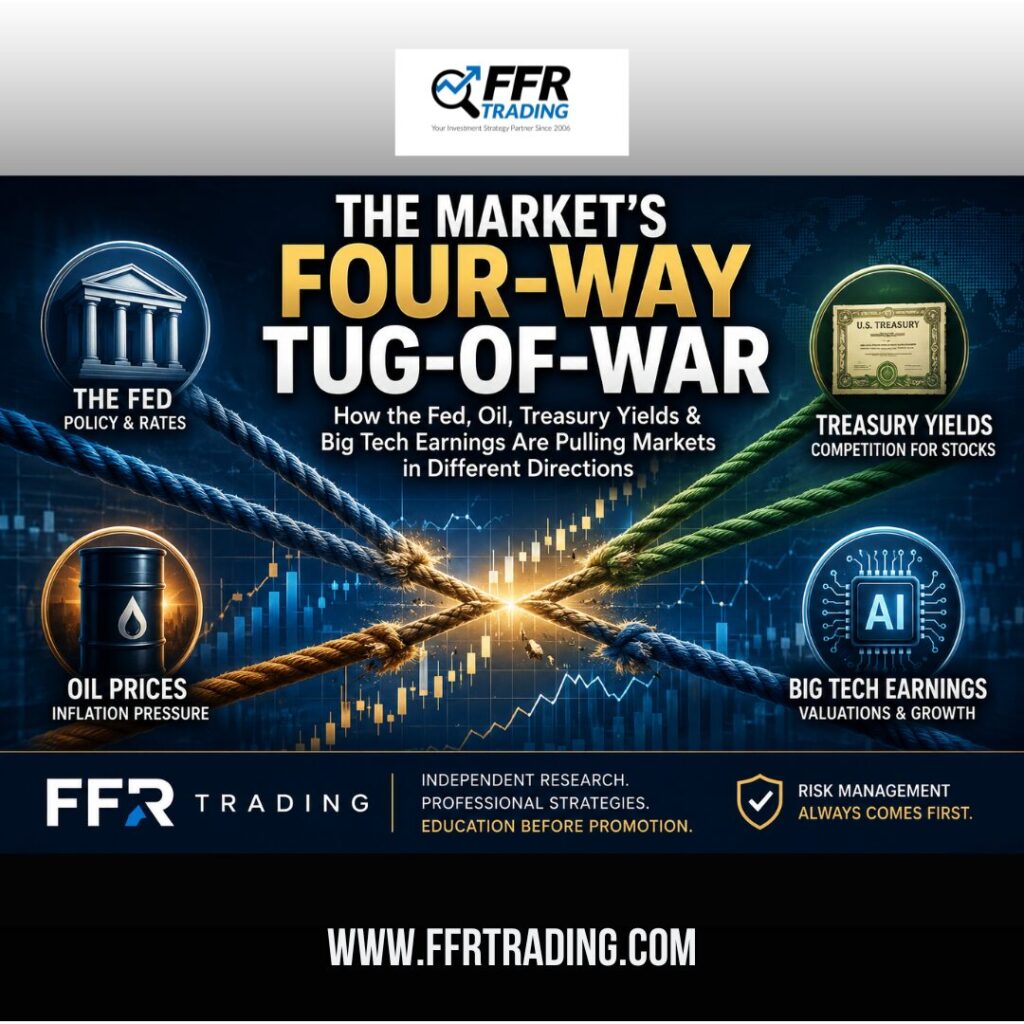
Markets rarely move because of a single headline. More often, they’re pulled in multiple directions by competing economic forces. This week is a perfect example.
The Federal Reserve, oil prices, Treasury yields, and Big Tech earnings are all competing for investors’ attention. Each has the power to influence market sentiment on its own, but together they create a complex environment that demands careful analysis—not emotional reactions.
For traders, this is not the time to predict what comes next. It’s the time to prepare for multiple scenarios, wait for confirmation, and manage risk with discipline.
Oil Prices Can Influence Inflation
Energy prices have long been one of the biggest drivers of inflation.
When oil prices rise, transportation, manufacturing, and production costs often increase. Businesses may pass those higher costs on to consumers, keeping inflation elevated even if other parts of the economy begin to cool.
For investors, higher oil prices aren’t just about what you pay at the pump—they can affect interest rates, corporate profits, and consumer spending.
Understanding this relationship helps traders see beyond the daily headlines.
Inflation Shapes Federal Reserve Policy
The Federal Reserve’s primary goal is to maintain stable prices while supporting maximum employment.
If inflation remains stubbornly high, policymakers may decide that interest rates need to stay elevated longer than investors expect—or even consider additional tightening.
Markets constantly adjust to changing expectations about future Fed policy. Sometimes it’s not the actual interest rate decision that moves prices, but rather the language the Fed uses when discussing inflation and the economy.
That’s why experienced traders pay close attention to both the decision and the commentary that follows.
Treasury Yields Compete with Stocks
Interest rates don’t just affect borrowing costs—they also influence where investors choose to put their money.
When Treasury yields rise, investors can earn attractive returns from government bonds with relatively low risk. That can reduce the appeal of stocks, particularly companies trading at premium valuations.
Higher yields can also increase financing costs for businesses, putting pressure on future earnings growth.
This relationship helps explain why strong economic news doesn’t always lead to higher stock prices. Sometimes positive economic data causes Treasury yields to rise, creating a headwind for equities.
Big Tech Must Continue Delivering
Large technology companies have been major drivers of recent market gains, fueled in part by excitement surrounding artificial intelligence.
However, investor expectations have also risen dramatically.
Companies investing billions of dollars into AI infrastructure must demonstrate that those investments can eventually translate into stronger revenue growth and improved profitability.
Strong earnings alone may not be enough. Investors will also evaluate forward guidance, spending plans, and management’s outlook for future growth.
In today’s market, expectations often matter just as much as results.
How These Forces Work Together
Rather than viewing each headline in isolation, think of the market as a system where every piece influences another.
- Higher oil prices can keep inflation elevated.
- Persistent inflation may encourage a more cautious Federal Reserve.
- Higher interest rates often push Treasury yields higher.
- Rising yields can pressure stock valuations.
- Corporate earnings must be strong enough to overcome those valuation concerns.
When you connect these relationships, the market becomes much easier to understand.
What Traders Should Focus On
Instead of trying to predict every market move, ask questions like:
- Is inflation showing signs of cooling?
- How are Treasury yields reacting to new economic data?
- Are corporate earnings exceeding expectations?
- Is price confirming the market narrative?
These questions encourage objective decision-making instead of emotional reactions.
The Bottom Line
Markets are constantly balancing multiple competing forces, and this week highlights that reality perfectly.
Rather than reacting to every headline, successful traders focus on preparation, confirmation, and disciplined execution. By understanding how oil prices, inflation, Federal Reserve policy, Treasury yields, and corporate earnings interact, you can better evaluate what is driving the market—and avoid making decisions based on a single news story.
At FFR Trading, our goal is to help traders think independently, evaluate evidence objectively, and make informed decisions based on risk management rather than emotion.
This is not a week for prediction. It’s a week for preparation, confirmation, and disciplined risk management.