
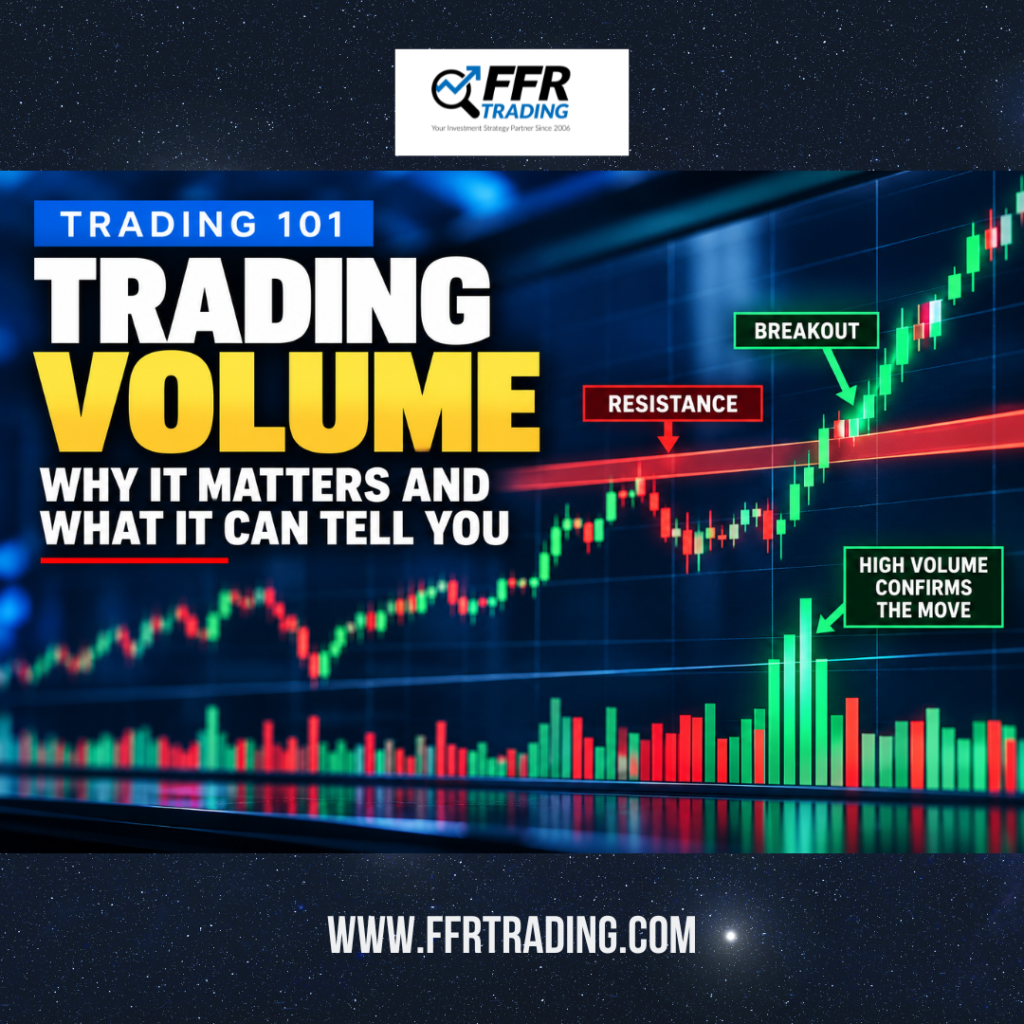
A stock breaks above resistance and starts moving higher.
Is it a real breakout—or could the move quickly fade?
One clue traders often look at is trading volume.
Volume won’t tell you exactly where a stock is headed next, but it can provide valuable information about how much participation is behind a price move.
What Is Trading Volume?
Trading volume simply measures the number of shares or contracts traded during a specific period.
If 5 million shares of a stock change hands during the day, its daily volume is 5 million shares.
But the number becomes more useful when you compare it with what’s normal for that stock.
A move occurring on unusually high volume may deserve more attention than the same move occurring on very light trading.
Why Volume Can Confirm a Price Move
Think of volume as a measure of participation.
Suppose a stock has repeatedly struggled to move above $50.
It finally breaks through $50 and closes at $52.
If that breakout occurs with significantly higher-than-normal volume, it suggests a larger number of market participants were involved in the move.
That doesn’t guarantee the stock will continue higher.
But it can provide additional evidence that the breakout has meaningful participation behind it.
What About a Breakout on Low Volume?
Now imagine the same stock breaks above $50, but volume is unusually light.
The breakout may still succeed, but some traders may treat it with more caution because fewer market participants appear to be supporting the move.
This is one reason traders often look for price and volume together rather than relying solely on price.
Volume Can Matter During Declines Too
Volume isn’t only useful when stocks are rising.
A sharp decline accompanied by heavy volume can indicate strong selling pressure.
On the other hand, a pullback occurring on relatively light volume may suggest less aggressive selling.
Again, neither situation predicts what happens next.
Volume simply provides additional context.
Don’t Use Volume in Isolation
Like support and resistance, volume isn’t a standalone trading system.
High volume doesn’t automatically make a trade good, and low volume doesn’t automatically make it bad.
Traders may combine volume with:
- Support and resistance
- Price trends
- Breakouts
- Volatility
- Momentum
- Broader market conditions
The objective is to build a weight of the evidence rather than making a decision based on one indicator.
The Trading Takeaway
Price tells you what the market is doing.
Volume can help tell you how much participation is behind the move.
When price approaches an important support or resistance level, don’t just watch whether it breaks.
Ask another question:
Is volume confirming the move?
That additional piece of information can help traders distinguish between a move worth investigating and one that may deserve more caution.