
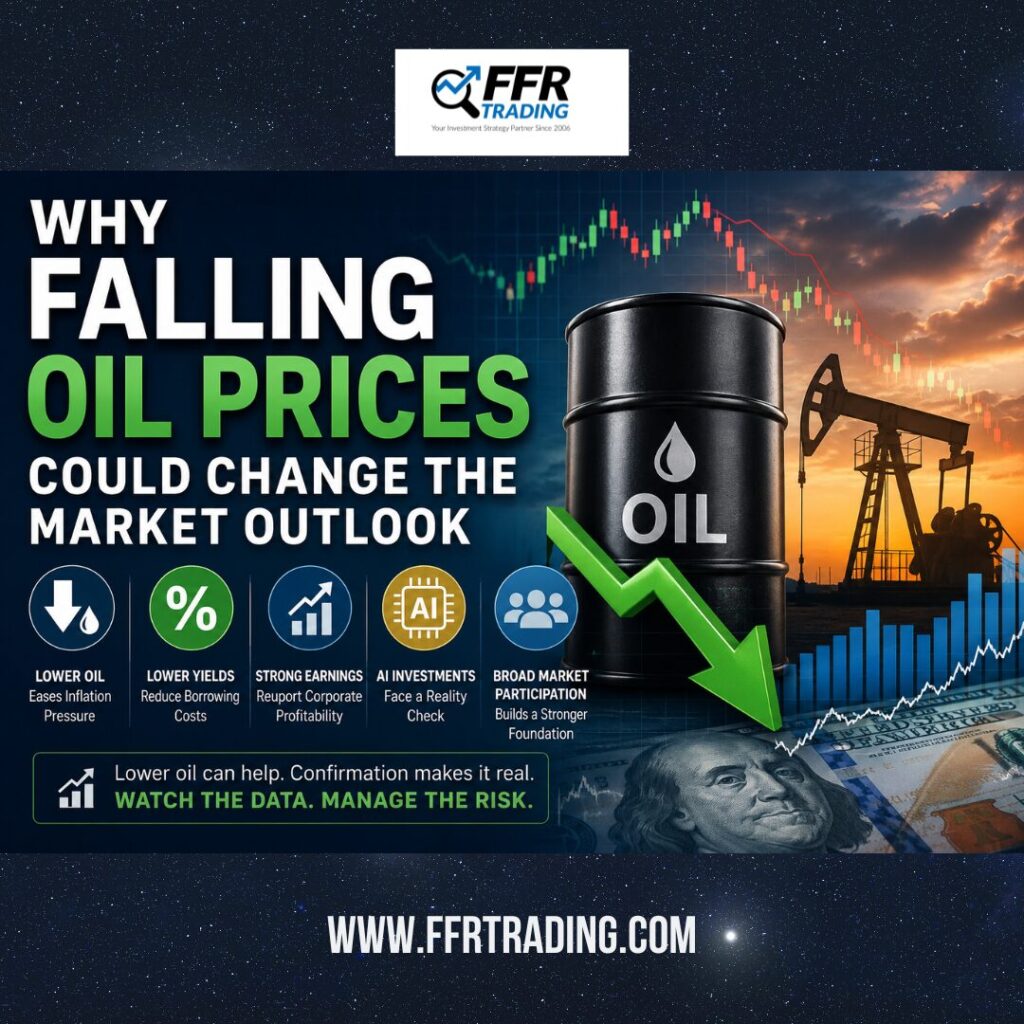
Over the past several days, falling oil prices and the stock market have become closely linked once again. As geopolitical tensions in the Middle East show signs of easing, crude oil has retreated sharply from recent highs, helping lift stock futures and easing pressure on Treasury yields. While that’s encouraging news for investors, falling oil prices alone won’t determine whether the market’s next move is higher.
For traders, the bigger question is whether lower energy prices will translate into improving market conditions—or if this is simply another short-lived, headline-driven rally.
Let’s take a closer look at why oil prices matter and what traders should be watching next.
Why Falling Oil Prices Matter to the Stock Market
Oil influences much more than the price you pay at the gas pump. It plays an important role in inflation, corporate costs, consumer spending, and interest rate expectations.
When crude oil rises significantly, businesses often face higher transportation, manufacturing, and operating expenses. Those increased costs can eventually work their way into consumer prices, keeping inflation elevated.
On the other hand, falling oil prices can help reduce inflationary pressure throughout the economy. Lower energy costs often improve corporate profit margins while giving consumers more disposable income. Both factors tend to support economic growth and investor sentiment.
However, the market doesn’t react to oil prices alone. Investors are also watching how lower energy costs affect Treasury yields and expectations for future Federal Reserve policy.
Lower Oil Prices Can Ease Pressure on Treasury Yields
One of the market’s biggest concerns throughout 2026 has been rising long-term Treasury yields.
Higher yields increase borrowing costs for businesses and consumers while reducing the present value of future corporate earnings. Growth stocks—particularly technology companies—often feel this pressure the most because investors are paying today for profits expected years into the future.
When oil prices decline, inflation expectations frequently moderate as well. If investors believe inflation will continue cooling, Treasury yields may stabilize or even decline, creating a more favorable environment for equities.
That’s one reason stocks responded positively as crude oil retreated this week.
Still, one trading session doesn’t establish a new trend. Traders should watch whether bond yields continue moving lower over the coming days rather than reacting to a single headline.
Strong Earnings Continue to Support the Market
Despite recent volatility, corporate earnings have generally remained impressive.
Many companies have exceeded analyst expectations, demonstrating that corporate America continues to generate healthy profits despite higher interest rates and ongoing economic uncertainty.
But there’s an important lesson for traders:
A company can beat earnings estimates and still see its stock decline.
That’s because markets don’t simply react to reported earnings. Investors evaluate:
- Future revenue guidance
- Profit margin expectations
- Capital spending plans
- Management commentary
- Current valuation
In today’s environment, expectations have become extremely high—especially for companies benefiting from artificial intelligence.
The AI Trade Faces Another Important Test
Artificial intelligence remains one of the market’s strongest long-term themes, but investors are becoming more selective.
Over the past year, companies have committed hundreds of billions of dollars toward AI infrastructure, data centers, and semiconductor development. Now investors want evidence that those investments are translating into sustainable revenue growth.
Upcoming earnings from major semiconductor companies could help determine whether recent weakness represents healthy profit-taking or the beginning of a broader valuation reset.
Rather than focusing solely on earnings-per-share, traders should pay close attention to:
- Data center growth
- AI-related revenue
- Gross margins
- Capital expenditures
- Forward guidance
These factors often matter more than the headline earnings number itself.
Market Breadth May Tell the Real Story
Many investors focus exclusively on the Nasdaq or the S&P 500, but broader market participation often provides better clues about the health of a rally.
When only a handful of mega-cap technology stocks lead the market higher, rallies can become increasingly fragile.
However, when small-cap stocks, mid-cap stocks, financials, industrials, and other sectors begin participating, the market’s foundation becomes much stronger.
That’s why professional traders monitor market breadth alongside price action.
If lower oil prices lead to improving participation across multiple sectors—not just technology—it would provide stronger confirmation that buyers are regaining control.
What Traders Should Watch This Week
Rather than trying to predict headlines, focus on the evidence.
Here are five developments worth monitoring:
- Can crude oil continue stabilizing after its recent decline?
- Do Treasury yields continue moving lower?
- Can technology stocks regain leadership?
- Does market breadth continue improving?
- How do investors react to this week’s earnings reports and economic data?
The answers to these questions will likely provide more valuable insight than any single geopolitical headline.
Risk Management Still Comes First
Markets can change direction quickly when geopolitical developments dominate the news cycle.
That’s why experienced traders focus on managing risk before chasing opportunity.
Consider:
- Waiting for price confirmation before entering trades.
- Reducing position size during periods of elevated uncertainty.
- Defining exit levels before placing a trade.
- Avoiding emotional reactions to breaking news.
Successful trading isn’t about predicting every headline—it’s about responding intelligently as new information develops.
The Bottom Line
Falling oil prices and the stock market are closely connected because lower energy costs can reduce inflation concerns, ease pressure on Treasury yields, and improve investor confidence.
But lower oil prices alone won’t determine the market’s next direction.
For a sustainable rally to develop, traders should look for confirmation through improving market breadth, supportive earnings, stable bond yields, and constructive price action.
At FFR Trading, our approach is built on independent analysis—not headlines. We believe successful traders benefit from understanding why markets move, not simply reacting to every news event. By combining technical analysis, risk management, and disciplined due diligence, traders can make more informed decisions regardless of the market environment.