
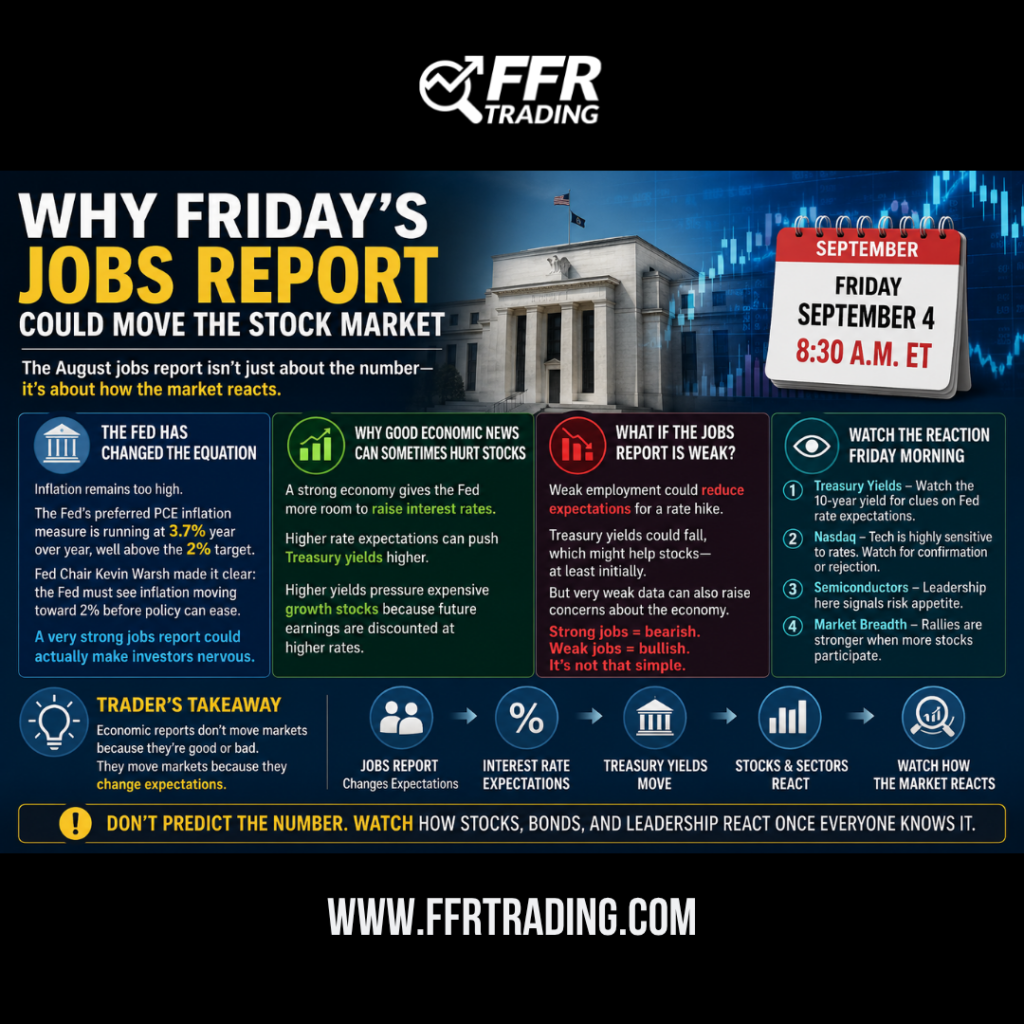
The August jobs report arrives Friday morning with considerably more riding on it than simply the number of jobs created.
The U.S. Bureau of Labor Statistics has scheduled the August Employment Situation report for Friday, September 4 at 8:30 a.m. ET.
Normally, investors want to see a strong labor market.
But this isn’t a normal interest-rate environment.
The Fed Has Changed the Equation
Fed Chair Kevin Warsh delivered an important message at Jackson Hole.
Inflation remains too high.
The Fed’s preferred PCE inflation measure is running at 3.7% year over year, considerably above its 2% target. Warsh said the Fed must become confident that underlying inflation is moving toward that objective at a sufficient pace—or policymakers still have work to do.
That creates an unusual market dynamic.
A very strong employment report could actually make investors nervous.
Why Good Economic News Can Sometimes Hurt Stocks
Suppose employment growth substantially exceeds expectations.
Normally that sounds bullish.
More jobs can mean stronger consumers, higher spending and a healthier economy.
But investors may reach another conclusion:
A strong economy gives the Fed more room to raise interest rates.
If expectations for higher rates increase, Treasury yields could rise.
Higher yields can pressure expensive growth stocks because investors discount their future earnings at higher interest rates.
That’s particularly important for technology.
What If the Jobs Report Is Weak?
A weaker report presents the opposite dilemma.
If employment growth disappoints again, investors could reduce expectations for a September rate hike.
Treasury yields could fall.
That might initially help growth stocks.
But there’s a point where weak employment stops being viewed as good news for interest rates and starts raising concerns about the economy.
That’s why traders shouldn’t reduce Friday’s report to:
Strong jobs = bearish.
or
Weak jobs = bullish.
Markets aren’t that simple.
Watch the Reaction
Instead, watch four things Friday morning.
1. Treasury yields
If the 10-year yield jumps following the report, the bond market may be signaling increased concern about Fed tightening.
2. Nasdaq
Technology has been especially sensitive to changes in rates.
Watch whether Nasdaq confirms or rejects the initial reaction.
3. Semiconductors
After Nvidia’s enormous earnings report, semiconductor leadership remains an important indicator of risk appetite.
4. Market breadth
A rally becomes considerably more convincing when participation extends beyond a handful of mega-cap stocks.
Trader’s Takeaway
Economic reports don’t move markets simply because they’re good or bad.
They move markets because they change expectations.
Friday’s employment report could change expectations about the economy, inflation and what the Federal Reserve does next.
So don’t try to predict the number.
Watch how stocks, bonds and market leadership react once everyone knows it.