
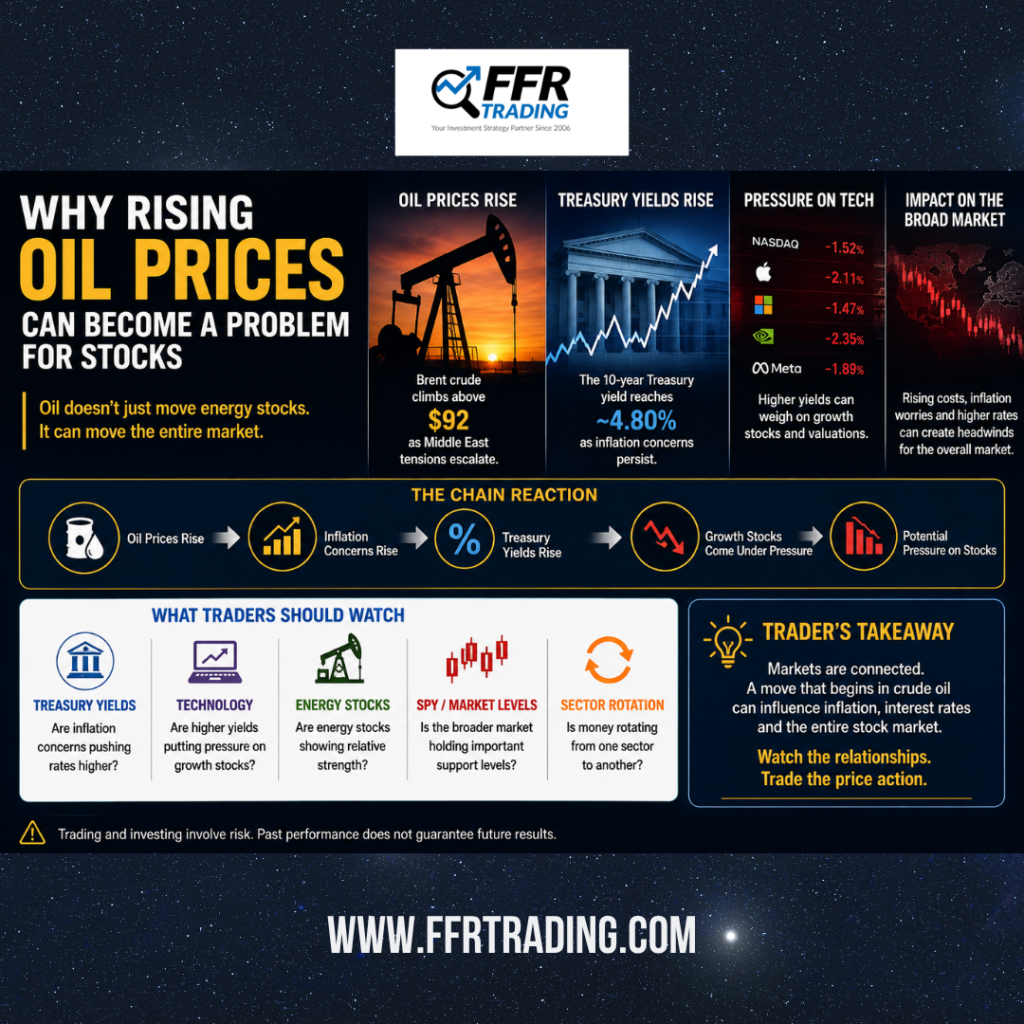
Oil prices are climbing again—and stock traders should pay attention.
It’s easy to think of crude oil as something that matters primarily to energy traders.
But a significant rise in oil can ripple through almost every part of the financial markets.
The reason comes down to one word:
Inflation.
Higher Oil Can Mean Higher Costs
Oil affects considerably more than the price you pay at the gas pump.
Transportation, manufacturing, shipping and many other parts of the economy are influenced by energy costs.
When oil prices rise sharply, businesses may face higher expenses.
Companies then have a choice:
Absorb those costs, which can hurt profit margins.
Or:
Pass those costs along to consumers, which can contribute to inflation.
Neither outcome is necessarily great for the stock market.
Then the Bond Market Gets Involved
This is where things become particularly interesting for traders.
If investors believe higher energy prices could keep inflation elevated, they may begin expecting interest rates to remain higher—or even rise further.
That can push Treasury yields higher.
And we’ve already discussed why that matters.
Higher yields can make bonds more competitive with stocks and put additional pressure on expensive growth companies.
Technology stocks can be particularly sensitive.
So the chain reaction can look something like this:
Oil rises → Inflation concerns rise → Treasury yields rise → Growth stocks come under pressure
It doesn’t happen every time, but it’s an important relationship to understand.
Not Every Stock Reacts the Same Way
There’s another lesson here.
Higher oil prices can hurt some areas of the market while helping others.
Airlines and transportation companies, for example, may face higher fuel expenses.
Some manufacturers could see costs increase.
Energy producers, on the other hand, may benefit from higher commodity prices.
That’s why a weak overall market doesn’t necessarily mean every sector is weak.
Money can simply rotate.
What Traders Should Watch
Rather than watching oil by itself, pay attention to how other markets respond.
If crude continues climbing, watch:
Treasury yields: Are inflation concerns pushing rates higher?
Technology: Are higher yields putting pressure on growth stocks?
Energy stocks: Are they showing relative strength?
SPY: Is the broader market holding important support levels?
Those relationships can tell you considerably more than the oil price alone.
Trader’s Takeaway
Markets are connected.
A move that begins in crude oil can eventually influence inflation expectations, Treasury yields, technology stocks and the broader market.
That’s why traders shouldn’t watch stocks in isolation.
Sometimes the most important clue about where stocks are headed is coming from another market entirely.
Trading and investing involve risk. Past performance does not guarantee future results.