
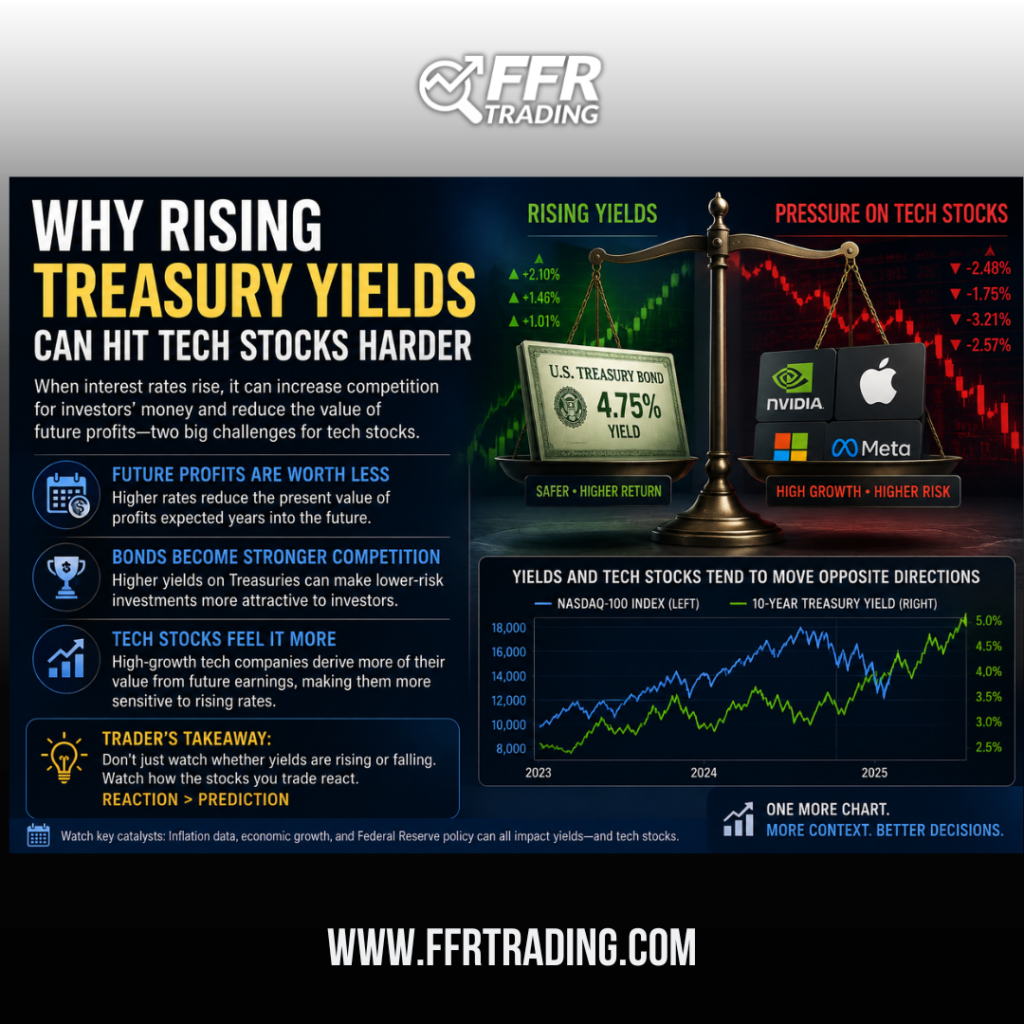
If you trade technology stocks, there’s another market you should probably be watching—even if you never plan to trade it.
The bond market.
Technology stocks have recently been feeling the pressure from elevated Treasury yields. Monday provided another example, with the Nasdaq falling 0.8% as semiconductor stocks weakened ahead of Nvidia’s earnings. On Tuesday morning, Treasury yields eased and technology stocks began rebounding.
That relationship isn’t accidental.
Here’s why Treasury yields can matter so much to growth stocks.
Higher Rates Change What Future Profits Are Worth
When investors buy a high-growth technology company, they’re often paying a premium today because they expect that company to generate significantly larger profits years from now.
But those future profits aren’t worth exactly the same amount today.
Investors use interest rates when determining the present value of future cash flows. When rates rise, those future profits become less valuable in today’s dollars.
The farther into the future those expected profits are, the greater the potential effect.
That’s one reason high-growth technology stocks can be particularly sensitive when long-term interest rates suddenly rise.
Bonds Also Become Stronger Competition
There’s another side to the equation.
Imagine Treasury securities suddenly offer investors significantly higher yields.
Investors now have another choice.
They can accept the volatility and uncertainty associated with stocks—or potentially earn a higher return than before from government debt.
That doesn’t mean investors suddenly abandon stocks.
But it can mean they demand more potential return to justify taking equity risk.
Expensive stocks can therefore become harder to justify when relatively lower-risk alternatives are paying more.
Why Tech Often Feels It First
Not every company responds to interest rates in the same way.
Many mature businesses generate substantial profits today.
High-growth technology companies, however, may derive much more of their valuation from expectations about what they’ll earn several years from now.
That can make them more sensitive to changes in the discount rate investors apply to those future earnings.
It’s also why traders occasionally see a strange-looking market:
Treasury yields rise.
Technology falls.
Other sectors hold up relatively well.
The underlying companies may not have changed at all.
What changed was the price investors were willing to pay for their future earnings.
Watch the Reaction, Not Just the Yield
There’s an important caveat.
Rising yields do not automatically mean technology stocks must fall.
Strong earnings, accelerating economic growth or improving corporate guidance can outweigh the pressure from interest rates.
That’s why the relationship itself matters more than any single yield level.
For example, the 10-year Treasury yield eased toward 4.68% Tuesday morning after recently trading around 4.70%, while technology stocks were positioned for a rebound.
Now consider what happens Wednesday when both PCE inflation and Nvidia earnings arrive.
If inflation cools and Treasury yields retreat while Nvidia delivers strong results, technology could receive two potential tailwinds.
But if inflation surprises higher and yields jump, even strong corporate results could face competition from the bond market.
Add One More Chart to Your Screen
You don’t need to become a bond trader to benefit from watching bonds.
If you actively trade technology stocks, consider keeping the 10-year Treasury yield on your radar.
Then ask:
When yields rise, how does technology respond?
When yields fall, do buyers return?
Is tech becoming more or less sensitive to rates?
Those relationships can provide valuable context that you won’t get from looking at a stock chart alone.
The Bottom Line
Stocks don’t trade in isolation.
Interest rates influence valuations, borrowing costs, investor expectations and the alternatives available for capital.
That’s why the bond market matters—even if you never trade a bond.
Trader’s Takeaway: Don’t simply watch whether Treasury yields are rising or falling. Watch how the stocks you trade react to those changes. That’s where the useful information often appears.