
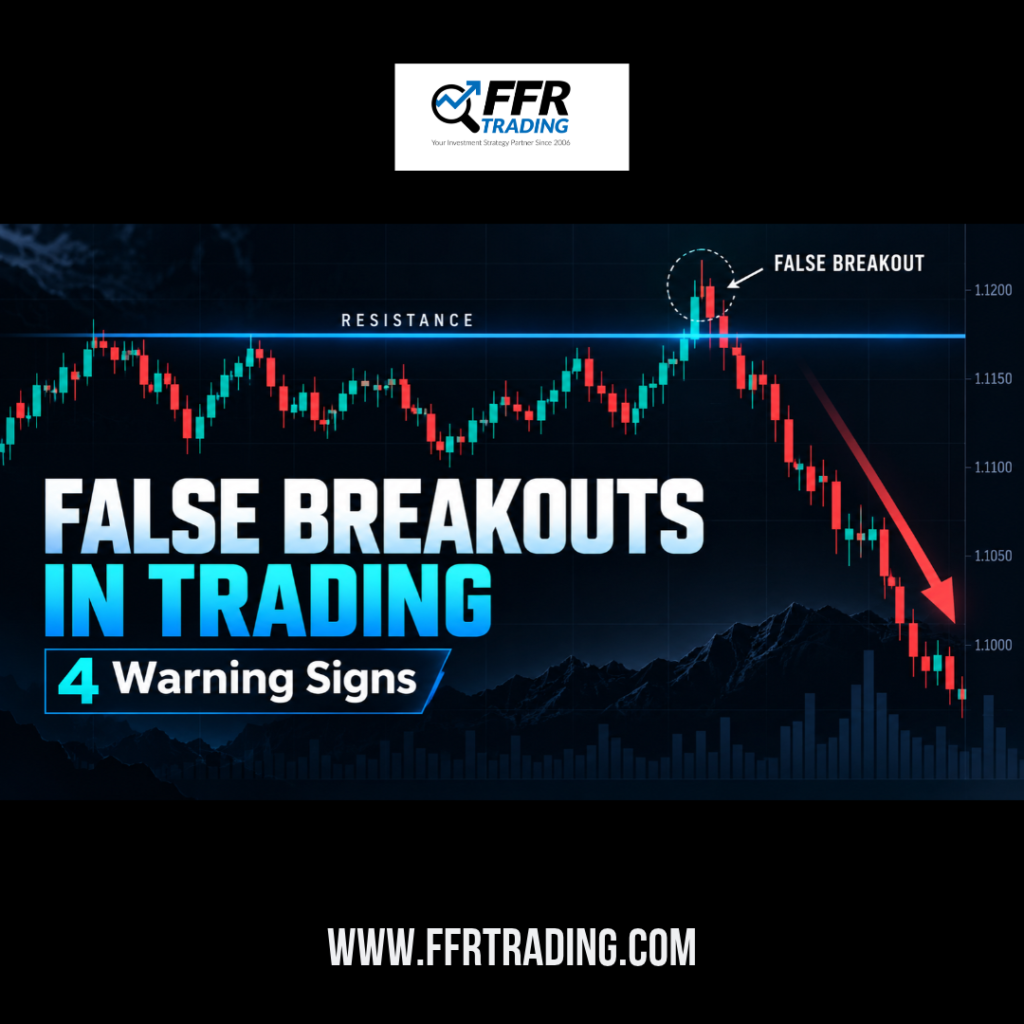
False breakouts in trading are among the most frustrating experiences for stock and options traders. A stock pushes through resistance, momentum accelerates, and buyers rush in expecting a major rally. Then, without warning, prices reverse, trapping traders who entered too early.
Understanding why these failed breakouts happen—and how to recognize the warning signs—can help traders avoid unnecessary losses and make more informed trading decisions.
What Are False Breakouts in Trading?
A breakout occurs when a stock, ETF, or market index moves beyond an established support or resistance level.
A bullish breakout happens when prices rise above resistance, while a bearish breakdown occurs when prices fall below support.
However, not every breakout leads to a sustained move.
A false breakout occurs when prices temporarily move beyond an important technical level but fail to maintain that momentum, eventually returning to the previous trading range.
For example, imagine a stock repeatedly struggling to break above $150.
Buyers finally push the price to $153, attracting traders anticipating a major rally.
But selling pressure quickly emerges, pushing shares back below $150.
What appeared to be a bullish breakout has suddenly turned into a warning sign.
This is why understanding support and resistance levels in technical analysis is essential when evaluating potential trading opportunities.
Why Do False Breakouts Happen?
False breakouts often reflect changes in the balance between buying and selling pressure.
Several factors can contribute:
1. Profit-Taking Near Resistance
Investors who purchased shares at lower prices may use a breakout as an opportunity to take profits. Their selling can overwhelm new buying demand.
2. Weak Institutional Participation
A breakout without meaningful participation from larger market participants may struggle to maintain momentum.
3. Stop Orders and Short Covering
A move above resistance can trigger buy-stop orders and force short sellers to cover their positions, temporarily accelerating prices without producing lasting buying pressure.
4. Market-Moving News
Earnings announcements, economic data, and Federal Reserve decisions can create dramatic initial reactions that reverse as traders digest the information.
As we explain in our article on trading around market-moving news, waiting for price confirmation can be particularly important during volatile market conditions.
Four Warning Signs of False Breakouts in Trading
While no technical indicator can predict every failed breakout, traders can look for clues that suggest a move may lack staying power.
1. Weak Volume During a Breakout
Trading volume provides insight into the strength behind a price move.
A breakout accompanied by expanding volume may indicate meaningful buying participation.
Conversely, when prices rise above resistance on unusually light volume, the move may lack conviction.
According to Charles Schwab’s educational research on trading volume, analyzing volume alongside price action can help traders evaluate whether a trend has meaningful participation.
Remember that high volume doesn’t guarantee a successful breakout. It is one piece of the confirmation process.
2. Price Fails to Hold Above Resistance
One of the clearest signs of a potential false breakout is a stock’s inability to remain above its former resistance level.
Suppose shares break above $100 but quickly retreat to $98.
The failure to hold above $100 suggests buyers may not have enough strength to sustain the advance.
Traders should evaluate not only whether resistance was broken, but also whether buyers can defend that level.
3. Long Upper Candlestick Shadows
Candlestick charts can reveal important shifts in market sentiment.
When a stock rallies sharply but closes near its opening price, it may produce a candle with a long upper shadow.
This suggests buyers initially controlled the session, but sellers eventually regained the upper hand.
When this occurs near major resistance, it can be an early indication that momentum is weakening.
4. Weak Market Breadth
A breakout in an individual stock may be less convincing if the broader market isn’t participating.
For example, a technology stock reaching new highs while the Nasdaq weakens and semiconductor stocks decline may face additional headwinds.
Market breadth helps traders determine whether strength is widespread or concentrated in a relatively small number of stocks.
Our previous analysis of SPY pullbacks and market breadth explains why broader participation matters when evaluating potential breakouts.
How to Avoid False Breakouts in Trading
One approach traders use is waiting for a breakout to demonstrate confirmation before entering.
Instead of immediately buying when a stock moves through resistance, they monitor whether prices can maintain that level.
Consider the following hypothetical example:
-
A stock trades between $95 and $100 for several weeks.
-
Buyers push the price above $100, triggering a breakout.
-
The stock rallies to $103 before pulling back.
-
Prices return toward $100, where buying interest emerges.
-
The stock stabilizes and begins advancing again.
In this scenario, the successful retest provides additional evidence that former resistance may be acting as support.
However, even a confirmed retest can fail. Traders should still define their downside risk before entering.
Risk Management Is Essential When Trading Breakouts
Recognizing false breakouts in trading is only part of the equation.
Managing risk when a breakout fails is equally important.
Before entering any breakout trade, ask yourself three questions:
Where is my entry?
Identify the conditions that would justify opening the trade rather than entering simply because prices are moving quickly.
Where will I exit if I’m wrong?
Determine the price level that would invalidate your setup and establish an appropriate risk limit.
Does the potential reward justify the risk?
Evaluate realistic profit targets relative to the amount of capital you’re willing to risk.
Stop-loss orders can help manage risk, although execution at the intended price is not guaranteed, particularly during fast markets.
For additional insights, read our article on protecting trading capital in overheated markets.
The Bottom Line: Confirmation Beats Impulse
False breakouts in trading remind us that price movement alone doesn’t guarantee a successful opportunity.
A stock moving above resistance doesn’t necessarily mean a new uptrend has begun.
Likewise, a breakdown below support doesn’t guarantee further selling.
Volume, price action, market breadth, and disciplined risk management can help traders make better-informed decisions.
With earnings season underway and another Federal Reserve decision approaching, traders should be particularly mindful of sudden moves that lack confirmation.
The first move isn’t always the right move.
Sometimes the smartest decision isn’t being the first trader into a breakout.
It’s having the patience to determine whether that breakout deserves your capital.
Stay disciplined, manage your risk, and remember: Protecting your capital is just as important as finding your next opportunity.
Educational content only. Not investment advice. All trading involves risk, including possible loss of principal. Past performance does not guarantee future results.